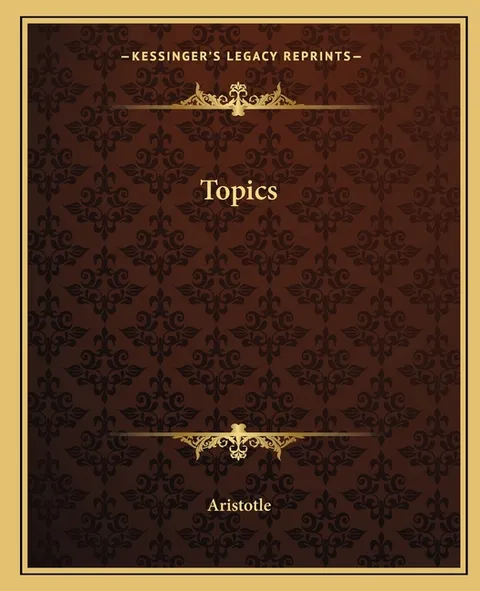
Topics
Report an issue
Tell us what's wrong and we'll take a look.
Thanks – we got it. We'll review and follow up if needed.
""Topics"" is a philosophical treatise written by Aristotle, one of the most influential thinkers in Western philosophy. The book is a comprehensive guide to the art of dialectic, or the practice of reasoned argumentation. Aristotle presents a detailed analysis of the various types of arguments that can be used in debate, and provides a framework for evaluating their effectiveness. He also explores the nature of knowledge, truth, and opinion, and offers insights into the relationship between language and thought. The book is divided into eight chapters, each of which focuses on a different aspect of dialectic. Topics covered include the principles of argumentation, the different types of propositions, the nature of contradiction, and the role of analogy in reasoning. Overall, ""Topics"" is a seminal work in the history of Western philosophy, and continues to be studied and debated by scholars to this day.Any 'property' rendered is always either essential and permanent or relative and temporary: e.g. it is an 'essential property' of man to be 'by nature a civilized animal': a 'relative property' is one like that of the soul in relation to the body, viz. that the one is fitted to command, and the other to obey.This scarce antiquarian book is a facsimile reprint of the old original and may contain some imperfections such as library marks and notations. Because we believe this work is culturally important, we have made it available as part of our commitment for protecting, preserving, and promoting the world's literature in affordable, high quality, modern editions, that are true to their original work.
Aristotle
Aristotle was an ancient Greek philosopher and scientist whose works have profoundly influenced philosophical discourse and scientific investigation from the later Greek period through to modern times. A student of Plato, Aristotle’s writings cover such disparate topics as physics, zoology, logic, aesthetics, and politics, and as one of the earliest proponents of empiricism, Aristotle advanced the belief that people’s knowledge is based on their perceptions.
In addition to his own research and writings, Aristotle served as tutor to Alexander the Great, and established a library at the Lyceum. Although it is believed that only a small fraction of his original writings have survived, works such as The Art of Rhetoric, Nicomachean Ethics, Poetics, and Metaphysics have preserved Aristotle’s legacy and influence through the ages.
More by Aristotle





Why Readwise Books?
Readwise Books is an ebook & audiobook platform that automatically logs how much you and your friends read, making it fun and easy to read more. Learn more →