Report an issue
Tell us what's wrong and we'll take a look.
Thanks – we got it. We'll review and follow up if needed.
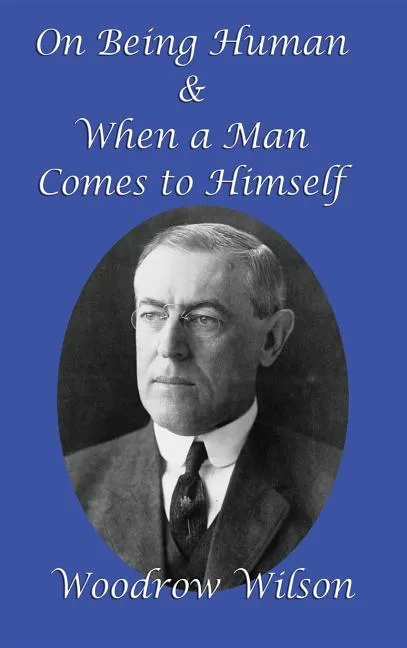
Before he became the 28th President of the United States (1913-21), the 34th Governor of New Jersey (1911-13), or even the 13th President of Princeton University (1902-10), Woodrow Wilson (1856-1924) was a scholar and professor. In 1885, he received his Ph.D. in history and political science from Johns Hopkins University, and in 1897, he was granted tenure at Princeton University.
As an educator, and a person of deep faith (his father was a Presbyterian reverend), Woodrow Wilson believed firmly in the importance of the humanities to human flourishing and freedom. In "On Being Human," Wilson sets out his vision for the good life, and offers insight into the foundations of his later political policies. "On Being Human" is among the most personal of Wilson's public writings, revealing an enthusiastic nature at odds with his later staid persona. While the essay makes little direct reference to faith, it does reveal Wilson's view of the good life, which is both hopeful and historical, and draws on both Aristotle's notion of "the golden mean" and Augustine's view of the ordo amorum (the order of the loves)-specifically, that the good life consists largely in a well-balanced, harmonious ordering of one's passions and priorities. Wilson's ideal is "the truly human man: a man in whom there is a just balance of faculties, a catholic sympathy-no brawler, no fanatic, no Pharisee, not too credulous in hope, not too desperate in purpose, warm, but not hasty, ardent, and full of definite power, but not running about to be pleased and deceived by every new thing."
"When a Man Comes to Himself," written just a few years later, reveals the wholesome and regenerating change which a man undergoes when he "comes to himself." It is not only after periods of recklessness or infatuation, when he has played the spendthrift or the fool, that a man comes to himself. He comes to himself after experiences of which he alone may be aware.
Woodrow Wilson
Thomas Woodrow Wilson, born to Joseph Ruggles Wilson and Jessie Janet Woodrow, was a political leader and academic who served as the 28th president of the United States from 1913 to 1921. Before his presidency, he was a prominent scholar and served as president of Princeton University, where he emphasized educational reform and academic excellence. Later, as governor of New Jersey, he became known for progressive legislative achievements that raised his national profile. A key figure of the Democratic Party, he won the 1912 presidential election by promoting a platform of reform called the New Freedom, which sought to tackle monopolies and strengthen individual rights. His presidency included significant legislative accomplishments such as the Federal Reserve Act and the Clayton Antitrust Act. During World War I, he initially kept the U.S. neutral but ultimately led the nation into the conflict, framing it as a fight to make the world safe for democracy. After the war, he championed the League of Nations, although the U.S. Senate rejected its membership. His later years were marked by declining health following a severe stroke in 1919, and he remained physically incapacitated for much of his final term. He died in 1924.
More by Woodrow Wilson





Why Readwise Books?
Readwise Books is an ebook & audiobook platform that automatically logs how much you and your friends read, making it fun and easy to read more. Learn more →