Report an issue
Tell us what's wrong and we'll take a look.
Thanks – we got it. We'll review and follow up if needed.
“There wasn’t that many people, but they were good people.”--Madeline Gilles
“First time I ever tasted cherries or even seen a cherry tree was [in White Bluffs]. Or ever ate an apricot or seen an apricot…It was covered with orchards and alfalfa fields.”--Leatris Boehmer Reid
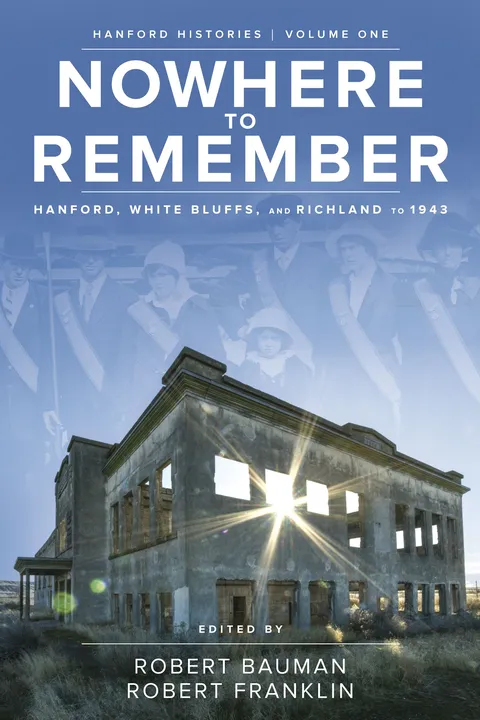
Euro-American Priest River Valley settlers turned acres of sagebrush into fruit orchards. Although farm life required hard work and modern conveniences were often spare, many former residents remember idyllic, close-knit communities where neighbors helped neighbors. Then, in 1943, families received forced evacuation notices. “Fruit farmers had to leave their crops on their trees. And that was very hard on them, no future, no money…they moved wherever they could get a place to live,” Catherine Finley recalled. Some were given just thirty days, and Manhattan Project restrictions meant they could not return.
Drawn from Hanford History Project personal narratives, Nowhere to Remember highlights life in Hanford, White Bluffs, and Richland--three small agricultural communities in eastern Washington’s mid-Columbia region. It covers their late 1800s to early 1900s origins, settlement and development, the arrival of irrigation, dependence on railroads, Great Depression struggles, and finally, their unique experiences in the early years of World War II.
David W. Harvey examines the impact of wagon trade, steamships, and railroads, grounding local history within the context of American West history. Robert Franklin details the tight bonds between early residents as they labored to transform scrubland into an agricultural Eden. Laura Arata considers the early twentieth century experiences of women who lived and worked in the region. Robert Bauman utilizes oral histories to tell forced removal stories. Finally, Bauman and Franklin convey displaced occupants’ reactions to their lost spaces and places of meaning--and explore ways they sought to honor their heritage.
David W. Harvey
David Harvey teaches at the Graduate Center of the City University of New York and is the author of many books, including Social Justice and the City, The Condition of Postmodernity, The Limits to Capital, A Brief History of Neoliberalism, Spaces of Global Capitalism, and A Companion to Marx's Capital. His website is http://davidharvey.org
More by David W. Harvey



Why Readwise Books?
Readwise Books is an ebook & audiobook platform that automatically logs how much you and your friends read, making it fun and easy to read more. Learn more →