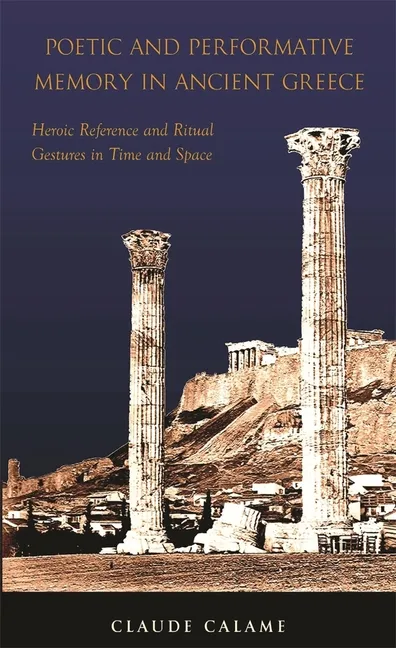
Poetic and Performative Memory in Ancient Greece
Heroic Reference and Ritual Gestures in Time and Space
Report an issue
Tell us what's wrong and we'll take a look.
Thanks – we got it. We'll review and follow up if needed.
Philosophers have often reflected on the Ancient Greeks' concepts of time, but an anthropological approach is necessary to understand their practical concept of time as tied to space. The Greeks not only spoke of time unfolding in a specific space, but also projected the past upon the future in order to make it active in the social practice of the present. Hesiod's history of humanity was intended to establish justice in the modern city; Bacchylides sang the celebration of the Athenian hero Theseus in a present-day cultic and ideological framework; the city of Cyrene used the heroic act of its founding to reaffirm its civic identity; and the Greeks embossed poetic texts on leaves of gold to ensure the ritual passage of the dead to a blessed afterlife. Explicating these examples, Poetic and Performative Memory in Ancient Greece shows how the Ancient Greeks' collective memory was based on a remarkable faculty for the creation of ritual and narrative symbols.
Claude Calame
Claude Calame is Director of Studies at the école des Hautes études en Sciences Sociales in Paris and Honorary Professor of Greek Language and Literature at the Université de Lausanne. He is the author of nearly a dozen books, including The Craft of Poetic Speech in Ancient Greece (also from Cornell), Choruses of Young Women in Ancient Greece, The Poetics of Eros in Ancient Greece, and most recently Myth and History in Ancient Greece. Peter M. Burk is a professional translator and a doctoral candidate in Classics at Princeton University.
More by Claude Calame



Why Readwise Books?
Readwise Books is an ebook & audiobook platform that automatically logs how much you and your friends read, making it fun and easy to read more. Learn more →