Report an issue
Tell us what's wrong and we'll take a look.
Thanks – we got it. We'll review and follow up if needed.
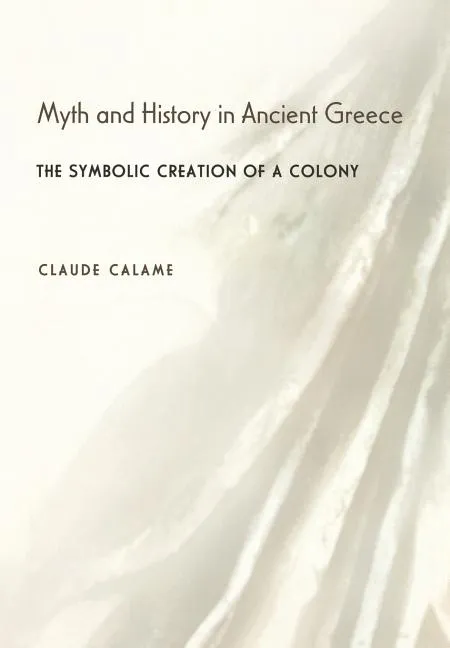
Surely the ancient Greeks would have been baffled to see what we consider their "mythology." Here, Claude Calame mounts a powerful critique of modern-day misconceptions on this front and the lax methodology that has allowed them to prevail. He argues that the Greeks viewed their abundance of narratives not as a single mythology but as an "archaeology." They speculated symbolically on key historical events so that a community of believing citizens could access them efficiently, through ritual means. Central to the book is Calame's rigorous and fruitful analysis of various accounts of the foundation of that most "mythical" of the Greek colonies--Cyrene, in eastern Libya.
Calame opens with a magisterial historical survey demonstrating today's misapplication of the terms "myth" and "mythology." Next, he examines the Greeks' symbolic discourse to show that these modern concepts arose much later than commonly believed. Having established this interpretive framework, Calame undertakes a comparative analysis of six accounts of Cyrene's foundation: three by Pindar and one each by Herodotus (in two different versions), Callimachus, and Apollonius of Rhodes. We see how the underlying narrative was shaped in each into a poetically sophisticated, distinctive form by the respective medium, a particular poetical genre, and the specific socio-historical circumstances. Calame concludes by arguing in favor of the Greeks' symbolic approach to the past and by examining the relation of mythos to poetry and music.
Claude Calame
Claude Calame is Directeur d'Études at the École des Hautes Études en Sciences Sociales, Paris.
More by Claude Calame






Why Readwise Books?
Readwise Books is an ebook & audiobook platform that automatically logs how much you and your friends read, making it fun and easy to read more. Learn more →