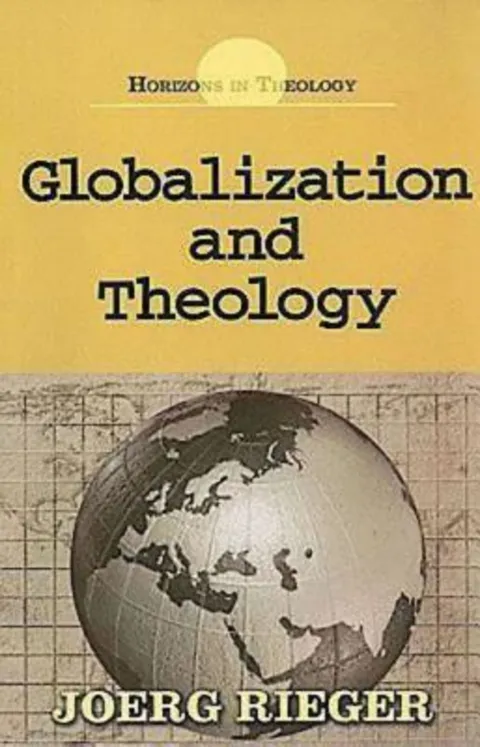
Globalization and Theology
Report an issue
Tell us what's wrong and we'll take a look.
Thanks – we got it. We'll review and follow up if needed.

Globalization is a catchword of our time, referring to the interdependence that affects us all. But we often meet globalization with extreme ambivalence, recognizing that it has both positive and negative consequences for economics, politics, and culture. Joerg Rieger makes the point that even theology, itself, can be a manifestation of globalization. At its worst, theology can reflect Western intellectual imperialism and at its best, theology can encourage a compelling vision of diversity within unity. The author articulates a theology of globalization as a diverse phenomenon that respects different ways of seeing and knowing, thus encouraging harmony rather than homogeny.
Joerg Rieger
Joerg Rieger is Distinguished Professor of Theology and Cal Turner Chancellor’s Chair in Wesleyan Studies, and the Director of the Wendland-Cook Program in Religion and Justice at Vanderbilt University, Nashville, Tennessee. His work addresses the relation of theology and public life, reflecting on the misuse of power in religion, politics, and economics. Author and editor of 27 books and over 210 academic articles, his books include Jesus vs. Caesar: For People Tired of Serving the Wrong God; No Religion but Social Religion: Liberating Wesleyan Theology; Unified We Are a Force: How Faith and Labor Can Overcome America’s Inequalities (with Rosemarie Henkel-Rieger); Faith on the Road: A Short Theology of Travel and Justice; and Occupy Religion: Theology of the Multitude (with Kwok Pui-lan).
More by Joerg Rieger





Why Readwise Books?
Readwise Books is an ebook & audiobook platform that automatically logs how much you and your friends read, making it fun and easy to read more. Learn more →