Report an issue
Tell us what's wrong and we'll take a look.
Thanks – we got it. We'll review and follow up if needed.
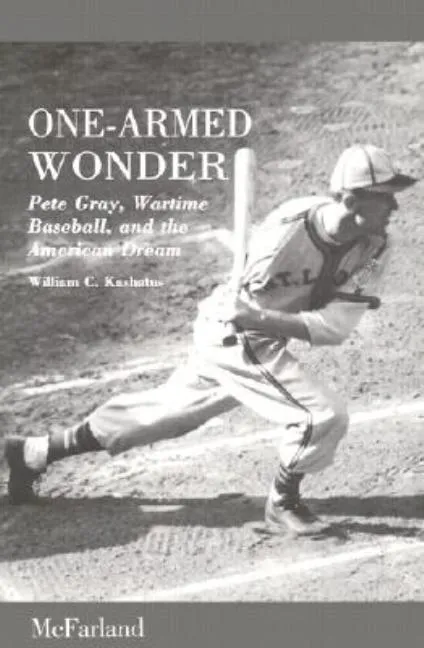
In the spring of 1945 Pete Gray, who had lost his right arm in a childhood accident, made his debut with the St. Louis Browns of the American League. Dubbed the "One-Amed Wonder" by sportswriters, Gray was a controversial figure from the moment he stepped on a major league diamond. Club owners saw him as a gate attraction for war-weary baseball fans; some of his teammates openly questioned his ability and felt that he cost them a chance to capture a second consecutive pennant. Gray was left to wonder just how good a ballplayer he really was.
Though some may have doubted Gray's ability, no one questioned the cantankerous outfielder's desire to reach the major leagues. From the coalfields of northeastern Pennsylvania, Pete Gray fought his way through the minor leagues with single-minded determination. Despite his missing arm, he was the most valuable player of the minor league's Southern Association in 1944. His on-field exploits and relentless fire became an inspiration to the many servicemen who returned from the battlefields of World War II with missing limbs.
William C Kashatus
William C. Kashatus, a professional historian and writer, is former Director of Educational Programs at Chester County Historical Society, West Chester, Pennsylvania, where he curated the nationally recognized exhibit Just over the Line: Chester County and the Underground Railroad. He taught history for fifteen years in Philadelphia schools, including Abington Friends School, The Episcopal Academy, and the William Penn Charter School. He is the author of more than 250 essays in major periodicals and has written 16 books, including Past, Present, and Personal: Teaching Writing in U.S. History (Heinemann, 2002).
More by William C Kashatus








Why Readwise Books?
Readwise Books is an ebook & audiobook platform that automatically logs how much you and your friends read, making it fun and easy to read more. Learn more →