Report an issue
Tell us what's wrong and we'll take a look.
Thanks – we got it. We'll review and follow up if needed.
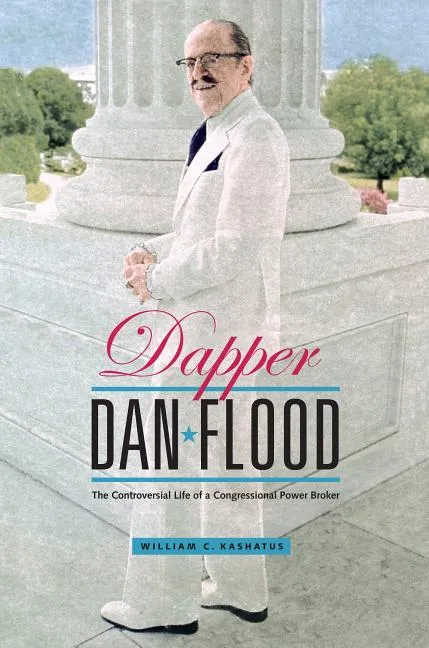
Daniel J. Flood was among the last of the old-time movers and shakers on Capitol Hill. A flamboyant vaudevillian who became a Democratic congressman from Pennsylvania, he was a sight on the House floor, sporting white linen suits, silk top hats, and dark, flowing capes. Flood presented his addresses and arguments with the overly precise and clipped accent of an old-fashioned stage actor, and he reveled in the attention he attracted for every performance.
At the same time, "Dapper Dan" understood the complexities of the old power politics and played the legislative game with sheer genius. He worked his will by employing the common practices that greased the wheels of the political process in the post-World War II era: persuasion, manipulation, arm-twisting, and grandiloquent oratory rarely matched by his congressional colleagues.
Between 1945 and 1980, Flood used his clout as a senior member of the House Appropriations Committee to wield near-veto power over the $300 billion federal budget. Flood was instrumental in funding the Cold War as well as the "Great Society" social reforms of the 1960s. This consummate pork-barrel politician was elected to the U.S. House of Representatives for sixteen terms. Eventually accused of improprieties in arranging federal contracts, Flood became the subject of sweeping investigations by the U.S. Attorney General and the House Ethics Committee.
Based on recently declassified FBI documents, court records, public papers, and contemporary newspaper accounts, as well as more than thirty interviews of Flood's widow, congressional colleagues, and Capitol Hill staff, Dapper Dan Flood explodes the myths surrounding this controversial Pennsylvania congressman.
William C Kashatus
William C. Kashatus, a professional historian and writer, is former Director of Educational Programs at Chester County Historical Society, West Chester, Pennsylvania, where he curated the nationally recognized exhibit Just over the Line: Chester County and the Underground Railroad. He taught history for fifteen years in Philadelphia schools, including Abington Friends School, The Episcopal Academy, and the William Penn Charter School. He is the author of more than 250 essays in major periodicals and has written 16 books, including Past, Present, and Personal: Teaching Writing in U.S. History (Heinemann, 2002).
More by William C Kashatus



Why Readwise Books?
Readwise Books is an ebook & audiobook platform that automatically logs how much you and your friends read, making it fun and easy to read more. Learn more →