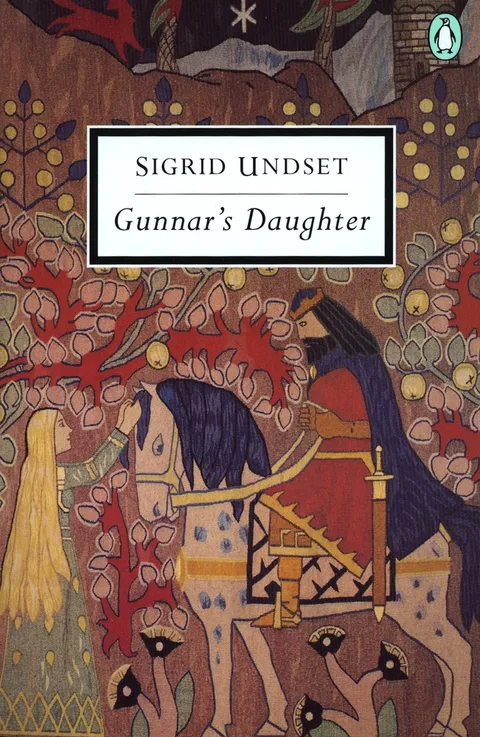
Gunnar's Daughter
Report an issue
Tell us what's wrong and we'll take a look.
Thanks – we got it. We'll review and follow up if needed.
A Penguin Classic
More than a decade before writing Kristin Lavransdatter, the trilogy about fourteenth-century Norway that won her the Nobel Prize, Sigrid Undset published Gunnar's Daughter, a brief, swiftly moving tale about a more violent period of her country's history, the Saga Age. Set in Norway and Iceland at the beginning of the eleventh century, Gunnar's Daughter is the story of the beautiful, spoiled Vigdis Gunnarsdatter, who is raped by the man she had wanted to love. A woman of courage and intelligence, Vigdis is toughened by adversity. Alone she raises the child conceived in violence, repeatedly defending her autonomy in a world governed by men. Alone she rebuilds her life and restores her family's honor--until an unremitting social code propels her to take the action that again destroys her happiness.
First published in 1909, Gunnar's Daughter was in part a response to the rise of nationalism and Norway's search for a national identity in its Viking past. But unlike most of the Viking-inspired art of its period, Gunnar's Daughter is not a historical romance. It is a skillful conversation between two historical moments about questions as troublesome in Undset's own time--and in ours--as they were in the Saga Age: rape and revenge, civil and domestic violence, troubled marriages, and children made victims of their parents' problems.
Sigrid Undset
Sigrid Undset (1882-1949), Norwegian novelist, essayist, and Catholic convert, was born in Denmark, the eldest daughter of a Norwegian father and a Danish mother. She converted to Catholicism in 1924 and became a lay Dominican. Undset's many published works include the novels Mrs. Marta Oulie, The Happy Age, Gunnar's Daughter, and Kristin Lavransdatter, her most famous work. In 1928, she received the Nobel Prize for Literature, becoming the third woman to be so honored.
Undset was an outspoken critic of Nazism and fled to Brooklyn, New York, upon the German occupation of Norway. She returned to her homeland in 1945 and two years later was awarded Norway's highest honor, the Grand Cross of the Order of Saint Olav, for her "distinguished literary work and for service to her country."
More by Sigrid Undset




Why Readwise Books?
Readwise Books is an ebook & audiobook platform that automatically logs how much you and your friends read, making it fun and easy to read more. Learn more →