Report an issue
Tell us what's wrong and we'll take a look.
Thanks – we got it. We'll review and follow up if needed.
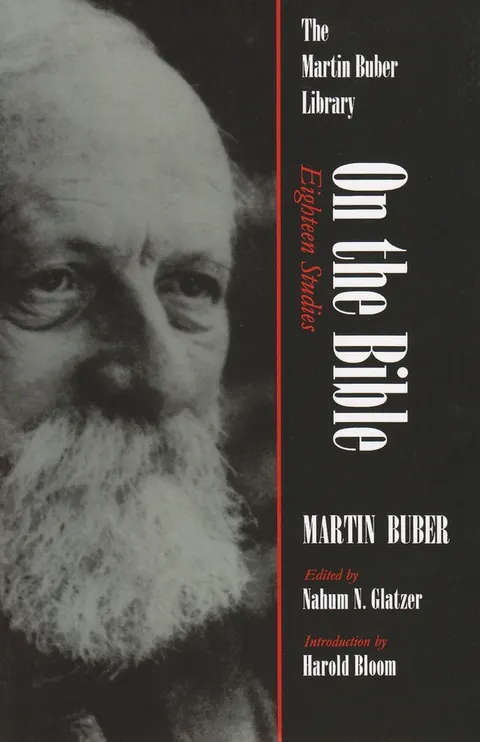
On the Bible acquaints the reader with Martin Buber's works on Scripture and with his endeavor to elucidate the meanings of biblical ideas in ages past and in our own time.
Martin Buber
Martin Buber (1878–1965) was an Austrian-born Jewish philosopher, essayist, translator, and editor most known for his German translation of the Bible, his religious existentialism philosophy, and his role in the Zionist movement. Buber grew up in Vienna during the rule of the Austro-Hungarian Empire, which fell after World War I. He was raised by his grandparents, who introduced him to Zionism and Hasidism at a young age. Buber had a knack for languages, learning more than ten during his school years. After school, Buber was recruited to lecture on Jewish religious studies at universities, educational centers, and Jewish groups. In 1938, as the Nazi Party gained power, Buber left Germany and settled in Jerusalem. He continued to lecture in Jerusalem at Hebrew University. Known for politically utopian ideals including anarchism and socialism, Buber became a leader in the Zionist movement and supported a bi-national solution to the Israel-Palestine conflict. In 1951, he received the Goethe Prize of the University of Hamburg and in 1953, the Peace Prize of the German Book Trade. In 1958, he won the Israel Prize. In 1963, he won the Erasmus Award in Amsterdam. He lived and worked in Jerusalem until his death in 1965.
More by Martin Buber








Why Readwise Books?
Readwise Books is an ebook & audiobook platform that automatically logs how much you and your friends read, making it fun and easy to read more. Learn more →