Report an issue
Tell us what's wrong and we'll take a look.
Thanks – we got it. We'll review and follow up if needed.
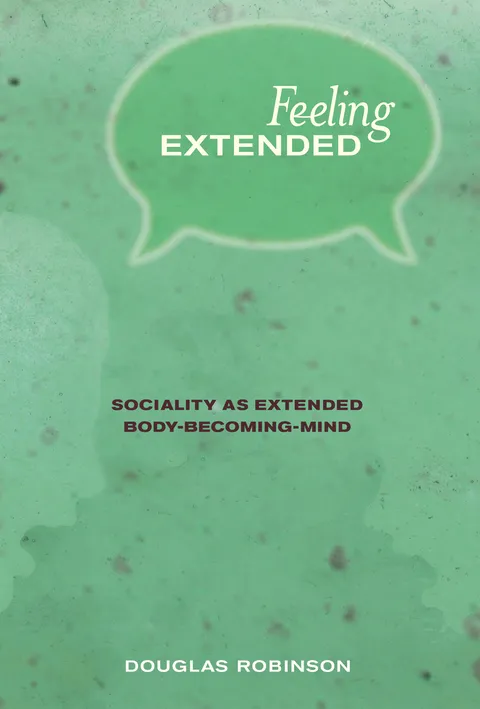
The extended-mind thesis (EMT), usually attributed to Andy Clark and David Chalmers, proposes that in specific kinds of mind-body-world interaction there emerges an extended cognitive system incorporating such extracranial supports as pencils, papers, computers, and other objects and environments in the world. In Feeling Extended, Douglas Robinson accepts the thesis, but argues that the usual debate over EMT—which centers on whether mind really (literally, actually, materially) extends to body and world or only seems to—oversimplifies the issue. When we say that mind feels as if it extends, Robinson argues, what extends is precisely feeling—and mind, insofar as it arises out of feeling.
Robinson explores the world of affect and conation as intermediate realms of being between the physical movements of body and the qualitative movements of mind. He shows that affect is transcranial and tends to become interpersonal conation. Affective-becoming-conative sociality, he argues, is in fact the primary area in which body-becoming-mind extends. To make his case, Robinson draws on a wide spectrum of philosophical thought—from the EMT and qualia debates among cognitivists to the prehistory of such debates in the work of Hegel and Peirce to continental challenges to Hegelianism from Bakhtin and Derrida—as well as on extensive empirical research in social psychology and important sociological theories of face (Goffman), ritual (Connerton), and habitus (Bourdieu).
Douglas Robinson
Douglas Robinson is Dean of Arts and Chair Professor of English at Hong Kong Baptist University. He is the author of many books, including Who Translates? Translator Subjectivities Beyond Reason, also published by SUNY Press.
More by Douglas Robinson




Why Readwise Books?
Readwise Books is an ebook & audiobook platform that automatically logs how much you and your friends read, making it fun and easy to read more. Learn more →