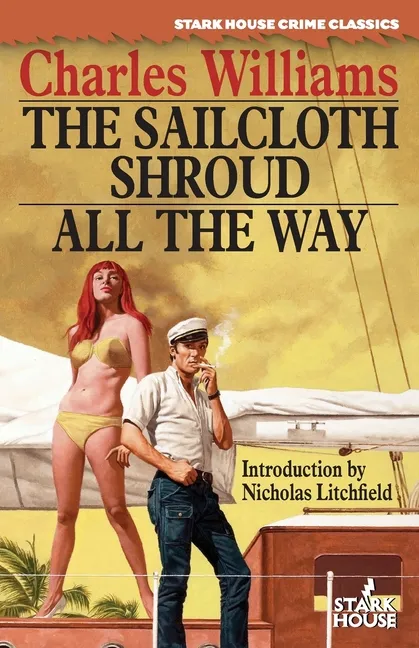
The Sailcloth Shroud / All the Way
Report an issue
Tell us what's wrong and we'll take a look.
Thanks – we got it. We'll review and follow up if needed.
THE SAILCLOTH SHROUD:
Stuart Rogers leaves Panama with two shipmates. One of them, Baxter, dies of a heart attack midway back to the States, and is buried at sea. Once they dock, the other man, Keefer, is fished out of the bay three days later after having been pistol-whipped to death. He had been seen flashing a lot of money around the night before. But as far as Rogers knew, Keefer was broke. Now the cops want to know where the money came from. They don't believe that Baxter really died at sea. Neither do the goons who pick up Rogers one night to beat the truth out of him. But if Baxter wasn't who he seemed to be, one thing Rogers knows for sure is that he's definitely dead-but who the hell was he?
ALL THE WAY:
Marian Forsyth made Harris Chapman the prosperous man he is today. As his private secretary, she advised him on his acquisitions, and turned him into a very wealthy man. She assumed she would become his second wife. But Harris made a foolish mistake: he fell in love with a younger, prettier woman. And now Harris must pay. And to that end, Marian creates a brilliant and detailed plan to steal $175,000 from him. All she needs is someone who sounds enough like Harris that he can become Harris long enough to pull it off. That's where Jerry Forbes comes in-footloose, morally flexible, and completely obsessed with Marian. It's the perfect match.... for the perfect crime.
Charles Williams
Charles Williams (1909–1975) was one of the preeminent authors of American crime fiction. Born in Texas, he dropped out of high school to enlist in the US Merchant Marine, serving for ten years before leaving to work in the electronics industry. At the end of World War II, Williams began writing fiction while living in San Francisco. The success of his backwoods noir Hill Girl (1951) allowed him to quit his job and write fulltime. Williams’s clean and somewhat casual narrative style distinguishes his novels—which range from hard-boiled, small-town noir to suspense thrillers set at sea and in the Deep South. Although originally published by pulp fiction houses, his work won great critical acclaim, with Hell Hath No Fury (1953) becoming the first paperback original to be reviewed by legendary New York Times critic Anthony Boucher. Many of his novels were adapted for the screen, such as Dead Calm (published in 1963) and Don’t Just Stand There! (published in 1966), for which Williams wrote the screenplay. Williams died in California in 1975.
More by Charles Williams









Why Readwise Books?
Readwise Books is an ebook & audiobook platform that automatically logs how much you and your friends read, making it fun and easy to read more. Learn more →