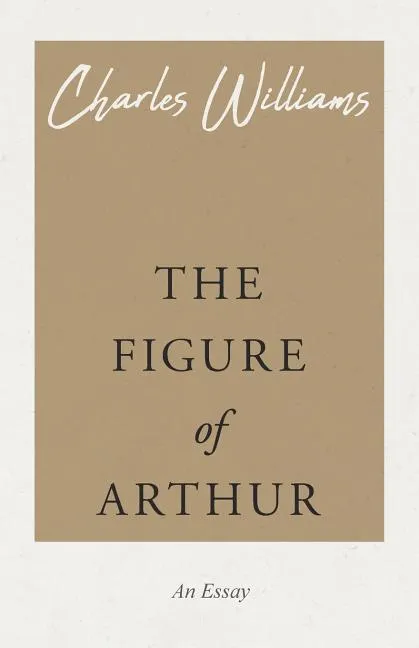
The Figure of Arthur
Report an issue
Tell us what's wrong and we'll take a look.
Thanks – we got it. We'll review and follow up if needed.
Charles Williams died in 1945 with this book unfinished: a prose history of King Arthur that follows the figure from the thin record of post-Roman Britain into the great medieval romances.
The Figure of Arthur was Williams's attempt to explain why the Arthurian story took the shape it did. He begins with what the earliest chronicles actually say, then watches poets and compilers enlarge it across fourteen centuries - Guinevere and Lancelot, Merlin, Gawaine, Morgan le Fay - and puts one question at the centre of his reading: does the king exist for the sake of the Grail, or the Grail for the sake of the king? The opening chapters were read aloud to J. R. R. Tolkien and C. S. Lewis before Williams's sudden death, and Lewis edited the surviving text and brought it out in 1948 in Arthurian Torso, alongside his own commentary on Williams's Arthurian poems.
Williams (1886-1945) spent most of his working life as an editor at Oxford University Press, writing poetry, plays, novels and theology around the day job. He is remembered now as the third of the Inklings, the Oxford circle he shared with Lewis and Tolkien, and for the two Taliessin cycles that this study was written to accompany.
This edition features:
- Williams's unfinished prose history of the Arthurian legend, the last major project of his life
- An account of how a shadowy war leader grew into the central figure of medieval storytelling
- The Grail argued as the heart of the whole matter, by a writer who was also a lay theologian
- Essential background for the Taliessin poems and for readers following the Inklings beyond Lewis and Tolkien
Charles Williams
Charles Williams (1909–1975) was one of the preeminent authors of American crime fiction. Born in Texas, he dropped out of high school to enlist in the US Merchant Marine, serving for ten years before leaving to work in the electronics industry. At the end of World War II, Williams began writing fiction while living in San Francisco. The success of his backwoods noir Hill Girl (1951) allowed him to quit his job and write fulltime. Williams’s clean and somewhat casual narrative style distinguishes his novels—which range from hard-boiled, small-town noir to suspense thrillers set at sea and in the Deep South. Although originally published by pulp fiction houses, his work won great critical acclaim, with Hell Hath No Fury (1953) becoming the first paperback original to be reviewed by legendary New York Times critic Anthony Boucher. Many of his novels were adapted for the screen, such as Dead Calm (published in 1963) and Don’t Just Stand There! (published in 1966), for which Williams wrote the screenplay. Williams died in California in 1975.
More by Charles Williams




Why Readwise Books?
Readwise Books is an ebook & audiobook platform that automatically logs how much you and your friends read, making it fun and easy to read more. Learn more →