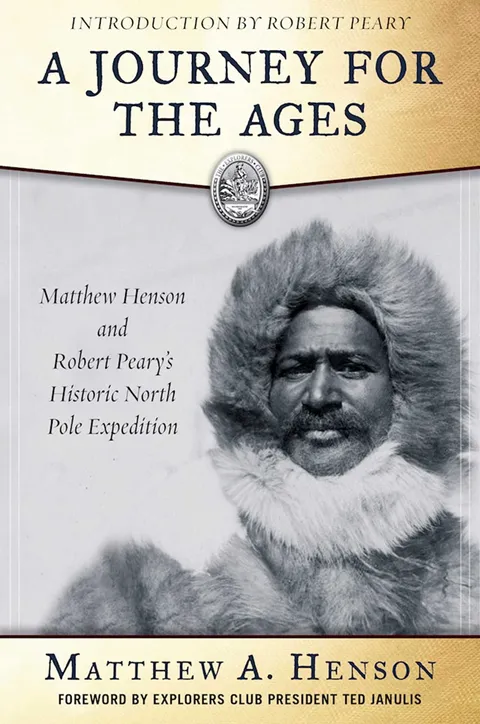
A Journey for the Ages
Matthew Henson and Robert Peary?s Historic North Pole Expedition
Report an issue
Tell us what's wrong and we'll take a look.
Thanks – we got it. We'll review and follow up if needed.
In an era when segregation thrived and Jim Crow reigned supreme, adventurer Matthew A. Henson defied racial stereotypes. During his teenage years, Henson sailed on vessels that journeyed across the globe, and it is those experiences that caught the attention of famed arctic explorer Matthew Peary. Operating as Peary’s “first man” on six expeditions that spanned over a quarter of century, Henson was an essential member of all of Peary’s most famous expeditions. His unparalleled skills as a craftsman and his mastery of the dialects of native Northern peoples, Henson was indispensable to the success of these missions.
Of all voyages which Henson and Peary undertook, none is more groundbreaking then their 1909 journey to Greenland, and onto the previously impenetrable North Pole. Together with a small team of four native Intuits, Henson and Peary became the first team to ever reach the geographic North Pole, forever cementing their place as two of the greatest Arctic explorers of all time. In 1937, the Explorer’s Club honored that achievement, inducting Henson as their first ever African-American member.
In 1912, Henson chronicled his recollections of this historic journey in a memoir originally entitled A Negro Explorer at the North Pole. Now reissued as First to the North Pole, this edition of Henson’s memoir features a new foreword by Explorer Club president Ted Janulis, emphasizing the importance of Henson’s historic achievements.
Skyhorse Publishing, along with our Arcade, Good Books, Sports Publishing, and Yucca imprints, is proud to publish a broad range of biographies, autobiographies, and memoirs. Our list includes biographies on well-known historical figures like Benjamin Franklin, Nelson Mandela, and Alexander Graham Bell, as well as villains from history, such as Heinrich Himmler, John Wayne Gacy, and O. J. Simpson. We have also published survivor stories of World War II, memoirs about overcoming adversity, first-hand tales of adventure, and much more. While not every title we publish becomes a New York Times bestseller or a national bestseller, we are committed to books on subjects that are sometimes overlooked and to authors whose work might not otherwise find a home.
Matthew Henson
Matthew Henson (1866-1955) was an African American explorer whose Arctic career combined seamanship, craftsmanship, and close working relationships with Inuit communities. He was born in Charles County, Maryland, shortly after the Civil War. His childhood included the loss of his parents, schooling in Washington, and an early departure for a life at sea. As a young sailor he acquired practical knowledge that would later prove valuable far beyond the routes of merchant ships.In 1887 Henson met the naval engineer Robert E. Peary while employed in a Washington shop. He accompanied Peary to Nicaragua and subsequently joined his northern ventures. Over nearly two decades, repeated Arctic journeys made Henson an experienced participant in expedition life. He learned to handle dogs and sledges, repair equipment, and work in conditions that demanded patience as much as physical endurance. Inuit knowledge and labor were fundamental to these journeys, and Henson's ability to communicate and collaborate formed part of his value to the expeditions.Henson belonged to the final traveling party on Peary's 1909 polar expedition, alongside Peary and four Inuit men. The party reported reaching the North Pole, a geographical claim that later investigators have questioned. Henson's importance does not depend on treating that claim as settled. His experience, field skills, and long service are distinct historical facts, even where the expedition's final position remains controversial.After returning to the United States, Henson worked at the New York Custom House rather than continuing a public career comparable to Peary's. His account appeared in 1912, providing a published record in his own name. He lived until 1955, receiving greater recognition in later years than during the expedition's immediate aftermath. His reinterment at Arlington National Cemetery in 1988 became a conspicuous acknowledgment of an explorer whose race had affected the recognition he received.Published in 1912, his memoir made expedition experience available under Henson's own name. Its attention to travel, equipment, and companions gives it a particular place within the literature of polar exploration. The narrative also belongs to the history of Black authorship, documenting a participant whose practical achievements could be acknowledged while his public status remained unequal to that of the expedition's leader.
More by Matthew Henson




Why Readwise Books?
Readwise Books is an ebook & audiobook platform that automatically logs how much you and your friends read, making it fun and easy to read more. Learn more →