Report an issue
Tell us what's wrong and we'll take a look.
Thanks – we got it. We'll review and follow up if needed.
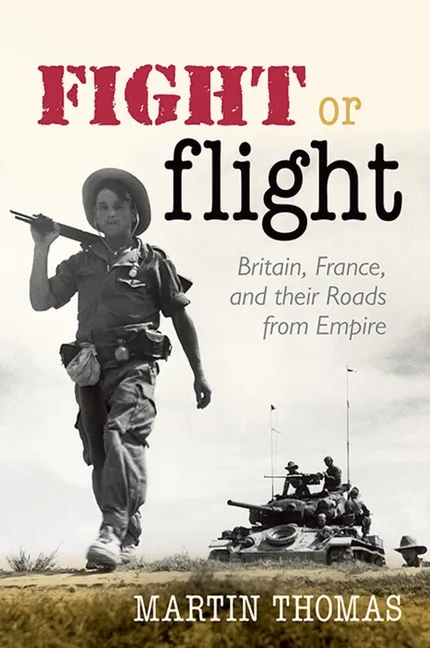
The collapse was cataclysmic. Peaceable 'transfers of power' were eclipsed by episodes of territorial partition and mass violence whose bitter aftermath still lingers. Hundreds of millions across four continents were caught up in the biggest reconfiguration of the international system ever seen.
In the meantime, even the most dogged imperialists, who had once stiffly defended imperial rule, ultimately bent to the wind of change. By the early 1950s Winston Churchill had retreated from his wartime pledge to keep Britain's Empire intact. And General de Gaulle, who quit the French presidency in 1946 complaining that France's new post-war democracy would never hang on to the country's imperial prizes, narrowly escaped assassination a generation later - after negotiating the humiliating French withdrawal from Algeria.
Fight or Flight is the first ever comparative account of this dramatic collapse, explaining the end of the British and French colonial empires as an intertwined, even co-dependent process. Decolonization gathered momentum, not as an empire-specific affair, but as a global one, in which the wider march of twentieth-century history played a vital part: industrial concentration and global depression, World War and Cold War, Communism and other anti-colonial ideologies, mass consumerism and the allure of American popular culture. Above all, as Martin Thomas shows, the internationalization of colonial affairs made it impossible to contain colonial problems locally, spelling the end for Europe's two largest colonial empires in less than two decades from the end of the Second World War.
Thomas Aquinas
Thomas Aquinas (1225-1274) lived at a critical juncture of western culture when the arrival of the Aristotelian corpus in Latin translation reopened the question of the relation between faith and reason. This crisis flared up just as universities were being founded. Thomas, after early studies at Montecassino, moved on to the University of Naples, where he met members of the new Dominican Order. When he joined the Dominican Order he went north to study with Albertus Magnus, author of a paraphrase of the Aristotelian corpus. Thomas completed his studies at the University of Paris. His theological writings became regulative of the Catholic Church and his close textual commentaries on Aristotle represent a cultural resource which is now receiving increased recognition.
More by Thomas Aquinas








Why Readwise Books?
Readwise Books is an ebook & audiobook platform that automatically logs how much you and your friends read, making it fun and easy to read more. Learn more →