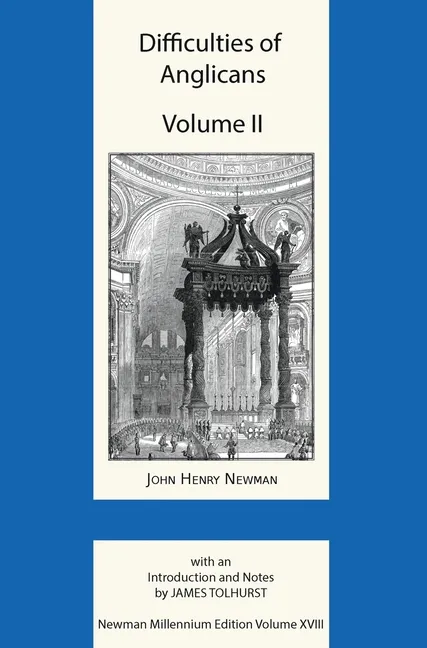
Difficulties of Anglicans Volume II
Report an issue
Tell us what's wrong and we'll take a look.
Thanks – we got it. We'll review and follow up if needed.
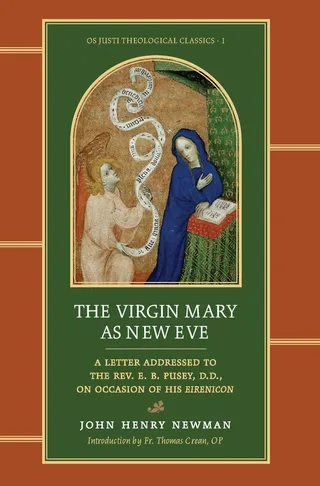
Anglican objections to Roman Catholic beliefs often focus on the status of the Virgin Mary and devotion to her, and that of the Pope and his exercise of supreme authority. In this second volume of Certain Difficulties felt by Anglicans John Henry Newman brought together two 'Open Letters' which address these key issues.
In A Letter Addressed to the Rev. E. B. Pusey, D.D., on Occasion of His Eirenicon (1866) Newman corrects the misconceptions of his former Oxford Movement colleague Professor Edward Pusey who had attacked Catholic Marian devotional practices. Newman expounds the early Fathers' teaching about Mary as the 'Second Eve' who was chosen to be the Mother of God; and he shows how Catholic devotion always honours her for the humility with which she accepted this call.
Nine years later William Gladstone, then the British prime Minister, published an attack on the 1870 promulgation of the doctrine of papal infallibility, arguing that it was unscriptural and was incompatible with the loyalty of Catholics to the British crown. Newman's reply, A Letter to the Duke of Norfolk (the leading Catholic layman in England), explains the exact meaning of the definition, as opposed to the extreme Catholic Ultramontane interpretation of it. He also gives a classic exposition of the true meaning of conscience and its relation to Church authority.
This first ever critical edition of these works has a substantial Editor's Introduction, examining the issues and setting the historical context, and provides comprehensive notes to Newman's text.
Newman collected both 'Letters' as Volume II of Difficulties Felt by Anglicans in Catholic Teaching. This is the first critical edition of this volume and contains detailed historical and critical introductions and footnotes to explain Newman's many historical and other references.
John Henry Newman
John Henry Newman was an influential theologian, philosopher, historian, and writer whose work shaped both Anglican and Catholic thought in the 19th century. Born on February 21, 1801, in London to Jemina Fourdrinier and John Newman, he showed early intellectual promise and later studied at Trinity College, Oxford. He initially served as an Anglican priest, where his academic and spiritual contributions made him a central figure in the Oxford Movement, which aimed to return the Church of England to its Catholic roots. Over time, his theological inquiries and personal convictions led him to convert to Catholicism in 1845, a decision that marked a turning point in his life and drew considerable attention. Newman became a Catholic priest and was eventually elevated to cardinal by Pope Leo XIII in 1879. His most notable works include Apologia Pro Vita Sua and The Idea of a University, through which he articulated his vision of faith, reason, and education. A gifted writer and poet, he continued his scholarly and pastoral work until his death on August 11, 1890, in Edgbaston, Birmingham. He left behind a legacy of spiritual depth and intellectual rigor that continues to resonate in religious and academic circles.
More by John Henry Newman


Why Readwise Books?
Readwise Books is an ebook & audiobook platform that automatically logs how much you and your friends read, making it fun and easy to read more. Learn more →