The Idea of a University
Report an issue
Tell us what's wrong and we'll take a look.
Thanks – we got it. We'll review and follow up if needed.
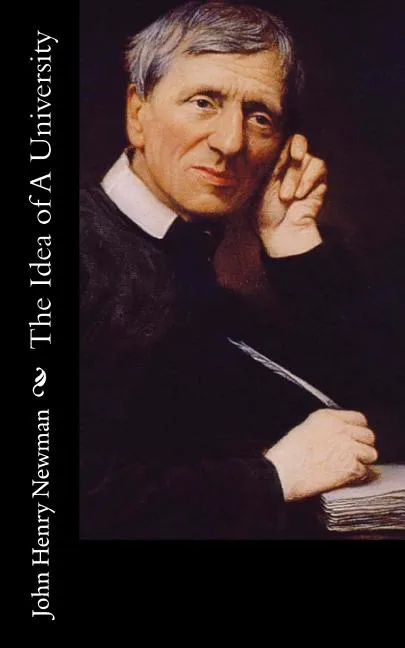

Cardinal John Henry Newman was a major figure in the Oxford Movement, a response by the members of the Church of England to a perceived attack by the reforming Whig administration who had already legislated a restructuring of the Church of Ireland. Members of the Oxford Movement feared the secular appropriation of ecclesiastical property and moved to assert their religious authority by returning the church to its Catholic origins. In 1854 John Henry Newman became the Rector of what would become University College, Dublin, a position he would remain in for four years. Based on his experiences as the leader of an educational institution he would publish a volume of lectures explaining his philosophy of education entitled "The Idea of a University." That work which is presented here is an early document of ideas around University education from the firsthand perspective of a man who had a hand in creating one. Religious and educational scholars alike will find much interest in this treatise by one of the most prominent of all religious literary figures.
John Henry Newman
John Henry Newman was an influential theologian, philosopher, historian, and writer whose work shaped both Anglican and Catholic thought in the 19th century. Born on February 21, 1801, in London to Jemina Fourdrinier and John Newman, he showed early intellectual promise and later studied at Trinity College, Oxford. He initially served as an Anglican priest, where his academic and spiritual contributions made him a central figure in the Oxford Movement, which aimed to return the Church of England to its Catholic roots. Over time, his theological inquiries and personal convictions led him to convert to Catholicism in 1845, a decision that marked a turning point in his life and drew considerable attention. Newman became a Catholic priest and was eventually elevated to cardinal by Pope Leo XIII in 1879. His most notable works include Apologia Pro Vita Sua and The Idea of a University, through which he articulated his vision of faith, reason, and education. A gifted writer and poet, he continued his scholarly and pastoral work until his death on August 11, 1890, in Edgbaston, Birmingham. He left behind a legacy of spiritual depth and intellectual rigor that continues to resonate in religious and academic circles.
More by John Henry Newman


Why Readwise Books?
Readwise Books is an ebook & audiobook platform that automatically logs how much you and your friends read, making it fun and easy to read more. Learn more →