Report an issue
Tell us what's wrong and we'll take a look.
Thanks – we got it. We'll review and follow up if needed.
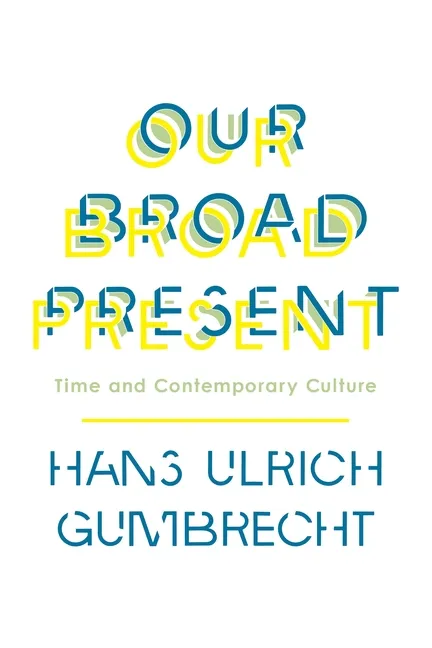
Considering a range of present-day phenomena, from the immediacy effects of literature to the impact of hypercommunication, globalization, and sports, Hans Ulrich Gumbrecht notes an important shift in our relationship to history and the passage of time. Although we continue to use concepts inherited from a "historicist" viewpoint, a notion of time articulated in the eighteenth and nineteenth centuries, the actual construction of time in which we live in today, which shapes our perceptions, experiences, and actions, is no longer historicist. Without fully realizing it, we now inhabit a new, unnamed space in which the "closed future" and "ever-available past" (a past we have not managed to leave behind) converge to produce an "ever-broadening present of simultaneities."
This profound change to a key dimension of our existence has complex consequences for the way in which we think about ourselves and our relation to the material world. At the same time, the ubiquity of digital media has eliminated our tactile sense of physical space, altering our perception of our world. Gumbrecht draws on his mastery of the philosophy of language to enrich his everyday observations, traveling to Disneyland, a small town in Louisiana, and the center of Vienna to produce striking sketches of our broad presence in the world.
Hans Ulrich Gumbrecht
Hans Ulrich Gumbrecht is the Albert Guérard Professor Emeritus in Literature in the Departments of Comparative Literature and French and Italian at Stanford University. As a public intellectual and highly prolific writer, he contributes to fields as diverse as the histories of national literatures in Romance languages, Western philosophical traditions, and forms of aesthetic experience in twenty first-century everyday culture. He has published more than two thousand texts, translated into more than twenty languages. His latest books are Atmosphere, Mood, Stimmung: On a Hidden Potential of Literature (2012), Explosionen der Aufklärung: Diderot, Goya, Lichtenberg, Mozart (2013), After 1945: Latency as Origin of the Present (2013), and Brüchige Gegenwart: Reflexionen und Reaktionen (2019).
More by Hans Ulrich Gumbrecht


Why Readwise Books?
Readwise Books is an ebook & audiobook platform that automatically logs how much you and your friends read, making it fun and easy to read more. Learn more →