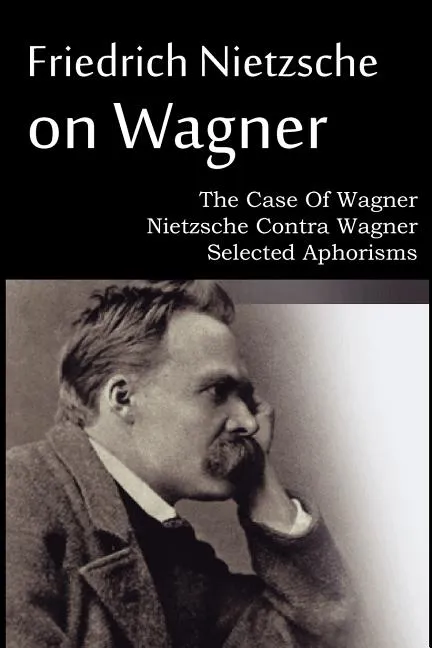
Friedrich Nietzsche on Wagner - The Case Of Wagner, Nietzsche Contra Wagner, Selected Aphorisms
Report an issue
Tell us what's wrong and we'll take a look.
Thanks – we got it. We'll review and follow up if needed.
In reading these essays we are apt to be deceived, by their virulent and forcible tone, into believing that the whole matter is a mere cover for hidden fire, -a mere blind of æsthetic discussion concealing a deep and implacable personal feud which demands and will have vengeance. In spite of all that has been said to the contrary, many people still hold this view of the two little works before us; and, as the actual facts are not accessible to everyone, and rumours are more easily believed than verified, the error of supposing that these pamphlets were dictated by personal animosity, and even by Nietzsche's envy of Wagner in his glory, seems to be a pretty common one. In Wagner's music, in his doctrine, in his whole concept of art, Nietzsche saw the confirmation, the promotion-aye, even the encouragement, of that decadence and degeneration which is now rampant in Europe; and it is for this reason, although to the end of his life he still loved Wagner, the man and the friend, that we find him, on the very eve of his spiritual death, exhorting us to abjure Wagner the musician and the artist. Friedrich Wilhelm Nietzsche was a 19th-century German philosopher, poet, composer and classical philologist. He wrote critical texts on religion, morality, contemporary culture, philosophy and science, displaying a fondness for metaphor, irony and aphorism.
Friedrich Nietzsche
Friedrich Nietzsche (1844-1900) was a German philosopher and philologist whose best-known works include Thus Spoke Zarathustra; Ecce Homo; Human, All Too Human; and Beyond Good and Evil. Much of his work is characterized by radical questioning of the value and objectivity of truth and criticism of traditional ideals of morality. Nietzsche's writings were significant influences on the existentialist, nihilist, and postmodernist schools of thought, as well as on the work of such later writers as Herman Hesse, Albert Camus, Sigmund Freud, and Jean-Paul Sartre.
More by Friedrich Nietzsche



Anthony M Ludovici
Translated by
Anthony M. Ludovici (1882-1971) was an English writer, philosopher, and translator, known for his work on Friedrich Nietzsche and his contributions to philosophical and political thought. Ludovici is best known for his writings on Friedrich Nietzsche. He was a prominent interpreter of Nietzsche's philosophy and made significant contributions to the understanding of Nietzsche's work. He wrote several books and articles on Nietzsche, including Nietzsche: His Life and Works, which provides a comprehensive overview of Nietzsche's philosophy and personal life. Ludovici was also known for his translations of Nietzsche's works, which helped to make Nietzsche's ideas more accessible to English-speaking audiences. Ludovici's work played a key role in the dissemination and interpretation of Nietzsche's ideas in the English-speaking world. His writings helped to shape the understanding of Nietzsche's philosophy and its impact on modern thought. His contributions to the study of Nietzsche remain significant, and his interpretations of Nietzsche's work continue to be referenced by scholars and readers interested in Nietzschean philosophy. Overall, Anthony M. Ludovici is remembered for his scholarly work on Friedrich Nietzsche and his efforts to promote and explain Nietzschean philosophy to a broader audience. His interpretations and translations have had a lasting impact on the study of Nietzsche and his ideas.


Why Readwise Books?
Readwise Books is an ebook & audiobook platform that automatically logs how much you and your friends read, making it fun and easy to read more. Learn more →