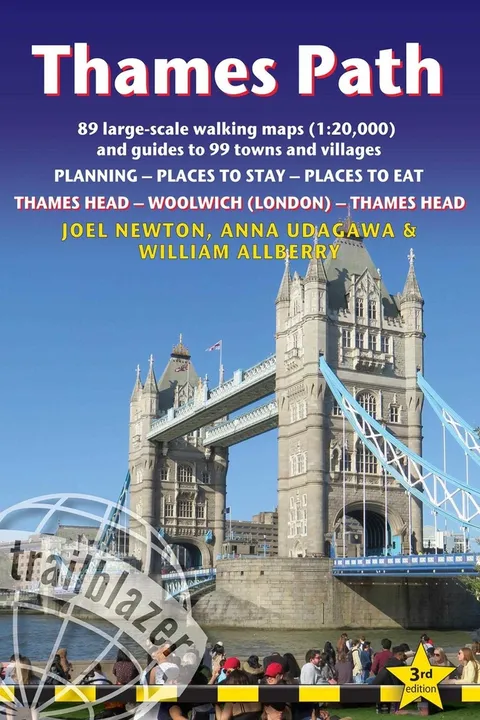
Thames Path
British Walking Guide: Thames Head to London - Includes 89 Large-Scale Walking Maps (1:20,000) & Guides to 99 Towns and Villages - Planning, Places to Stay, Places to Eat
Report an issue
Tell us what's wrong and we'll take a look.
Thanks – we got it. We'll review and follow up if needed.
The path begins, as the river does, in a meadow in the Cotswolds; its upper reaches lonely and wild, the meadows and banks the domain of waterfowl and willows; a collage of wild flowers, otters, fishermen and farmers. As the waters deepen and spread the settlements along its banks gradually begin to grow in both size and grandeur, and reaching Oxford, the solitude of the river slowly subsides and the trail becomes as much about historic towns, churches, abbeys and castles as it does the river. Lechlade, Abingdon, Wallingford, Henley ... they all owe their location to the Thames, and different eras, when the river was a life source, a place of conflict, a boundary, a mode of transport and the provider of leisure, which, thankfully--for us, at least--it remains to this day. Squeezing through the ancient Goring Gap, loomed over by the Chiltern Hills, you pass Runnymede--the site of the signing of Magna Carta--and Windsor Castle; where the aeroplanes overhead hint at the ominous size of the city to come.
Walking in London is not as blighted by sound, fury and concrete as many may imagine, as the river--and especially the route along the south bank in London--remains relatively countrified, at least as far as Putney, from which the approaching sights of Westminster and Tower Bridge offer comparably fine vistas to anywhere along the Thames' green and scenic upper reaches. Leaving central London, the regenerated dockland areas of East London (ideas of what constitutes 'wild' in the modern world are of course open to debate) lure you to your journey's end and the conclusion of a most enjoyable and magnificently-varied riparian ramble, quite like no other in Britain.
Yet the Thames Path is more than just a trek, more than a long walk, more than just a national trail; the river acts as a postgraduate course in the history of a nation, a counselor to the modern world, a reminder of the importance of protecting the natural habitats which gave us what we have....
But most importantly--at least, for those wishing to spend some time in the river's company, and indeed planning on doing so with the help of this book--the Thames Path is a fluvial escapade of the finest kind.
- Includes 90 walking maps--the largest-scale maps available. At a scale of just under 1:20,000 (8cm or 3-1/8 inches to one mile) these are bigger than the most detailed walking maps currently available in the shops.
- Unique mapping features--walking times, directions, tricky junctions, places to stay and eat, points of interest. These are not general-purpose maps but fully-edited maps drawn by walkers for walkers.
- Itineraries for all walkers--whether hiking the 184-mile route in its entirety or sampling the highlights on day walks or short breaks.
- Includes detailed public transport information for all access points.
- Practical information for all budgets--what to see, where to stay, where to eat: pubs, hotels, B&B, camping, bunkhouses, hostels.
- GPS waypoints. These are also downloadable from the Trailblazer website.
- Plus--extra color sections: 16pp color introduction and 16pp of color mapping for stage sections (one stage per page) with trail profiles.
Joel Newton
Joel Newton is the Director of Technology Services at the Illinois Holocaust Museum & Education Center and a member of Congregation B'nai Jehoshua Beth Elohim (BJBE) in Deerfield, IL. In 2021, he converted to Judaism and joined the BJBE board as the Social Action / Social Justice chairperson. He earned a master's degree in philosophy from University College Dublin. He lives with his family in Northbrook, IL. You can learn about his other interests at joelgnewton.com.
More by Joel Newton



Why Readwise Books?
Readwise Books is an ebook & audiobook platform that automatically logs how much you and your friends read, making it fun and easy to read more. Learn more →