Report an issue
Tell us what's wrong and we'll take a look.
Thanks – we got it. We'll review and follow up if needed.
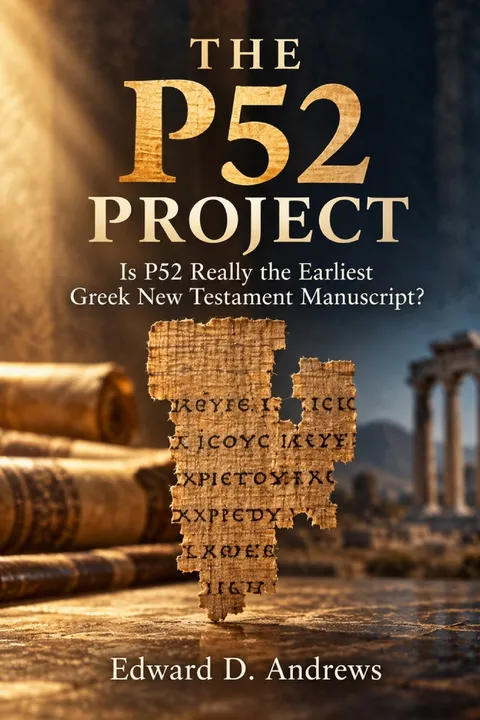
For decades, Papyrus 52 has held a prominent place in discussions of the earliest surviving Greek New Testament manuscripts. This small fragment of John's Gospel has also become the subject of a substantial scholarly dispute. Does its handwriting support an early second-century date, or should it be assigned a later date or a broader chronological range? How should Christians evaluate conflicting conclusions from respected specialists? The P52 Project brings the evidence and arguments before readers who want to understand the reasons behind the proposed dates.
Edward D. Andrews examines the case developed by Colin H. Roberts, the contributions of Philip Comfort and Stanley Porter, and the challenges raised by scholars advocating revised dates. He explains how ancient handwriting is compared, why the Egerton Gospel matters, and how individual scribal features should be weighed within the overall manuscript evidence. Photographs and comparative illustrations help readers follow the investigation without requiring specialized training in Greek paleography. The book defends the substantial evidence for an early second-century date while distinguishing what P52 supports from what the fragment cannot independently prove. Written for Bible students, pastors, teachers, and Christian apologists, this study equips readers to assess scholarly claims and understand P52's significance for the early transmission of John's Gospel.


Why Readwise Books?
Readwise Books is an ebook & audiobook platform that automatically logs how much you and your friends read, making it fun and easy to read more. Learn more →