Report an issue
Tell us what's wrong and we'll take a look.
Thanks – we got it. We'll review and follow up if needed.
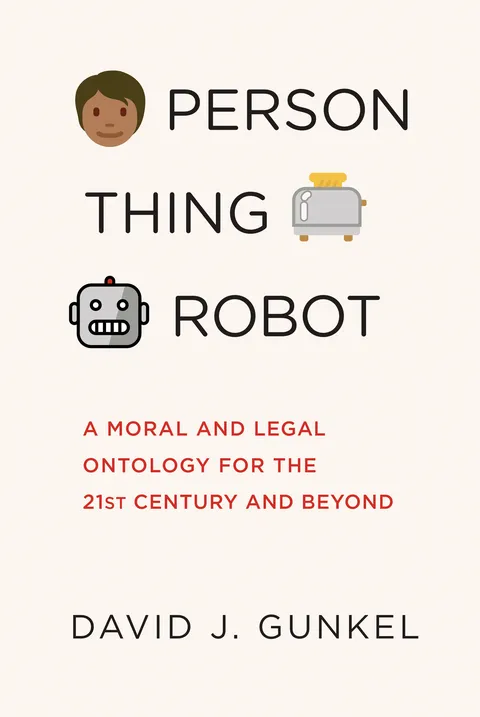
Why robots defy our existing moral and legal categories and how to revolutionize the way we think about them.
Robots are a curious sort of thing. On the one hand, they are technological artifacts—and thus, things. On the other hand, they seem to have social presence, because they talk and interact with us, and simulate the capabilities commonly associated with personhood. In Person, Thing, Robot, David J. Gunkel sets out to answer the vexing question: What exactly is a robot? Rather than try to fit robots into the existing categories by way of arguing for either their reification or personification, however, Gunkel argues for a revolutionary reformulation of the entire system, developing a new moral and legal ontology for the twenty-first century and beyond.
In this book, Gunkel investigates how and why efforts to use existing categories to classify robots fail, argues that “robot” designates an irreducible anomaly in the existing ontology, and formulates an alternative that restructures the ontological order in both moral philosophy and law. Person, Thing, Robot not only addresses the issues that are relevant to students, teachers, and researchers working in the fields of moral philosophy, philosophy of technology, science and technology studies (STS), and AI/robot law and policy but it also speaks to controversies that are important to AI researchers, robotics engineers, and computer scientists concerned with the social consequences of their work.












Why Readwise Books?
Readwise Books is an ebook & audiobook platform that automatically logs how much you and your friends read, making it fun and easy to read more. Learn more →