Report an issue
Tell us what's wrong and we'll take a look.
Thanks – we got it. We'll review and follow up if needed.
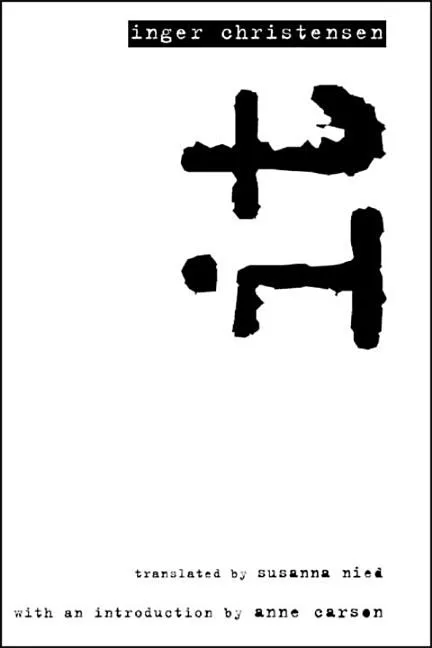
it is the masterwork by Danish poet Inger Christensen ("a true singer of the syllables," said C. D. Wright), often cited as a Nobel contender and one of Europe's most revered poets. On its publication in 1969, it took Denmark by storm, winning critical praise and becoming a huge popular favorite. Translated into many languages, it won international acclaim and is now a classic of modern Scandinavian poetry.
it is both a collection of poems and a single poetic epic, forming a philosophical statement on the nature of language, perception, and reality. The subject matter, though, is down to earth: amoebas, stones, and factories; fear, sea urchins, and mental institutions; sand, sexuality, and song. The words and images of it recur in ways reminiscent of Christensen's other works, but here is a younger poetry, wilder, and crackling with energy. The marvelous and complex use of mathematical structure in it is faithfully captured in Susanna Nied's English translation, which won a 2005 PEN Translation Fund Award.
Inger Christensen
Inger Christensen (1935- 2009), whose work is a cornerstone of modern Scandinavian poetry, was the recipient of many international awards, among them the Nordic Authors' Prize, bestowed by the Swedish Academy and known as the "Little Nobel." Her books include the masterpiece it; alphabet; Butterfly Valley; and Light, Grass, and Letter in April.
More by Inger Christensen
Susanna Nied
Translated by
Susanna Nied's work has appeared in various literary journals and anthologies. Her translation of It won the Harold Morton Landon Translation Award in 2007.


Why Readwise Books?
Readwise Books is an ebook & audiobook platform that automatically logs how much you and your friends read, making it fun and easy to read more. Learn more →