Report an issue
Tell us what's wrong and we'll take a look.
Thanks – we got it. We'll review and follow up if needed.
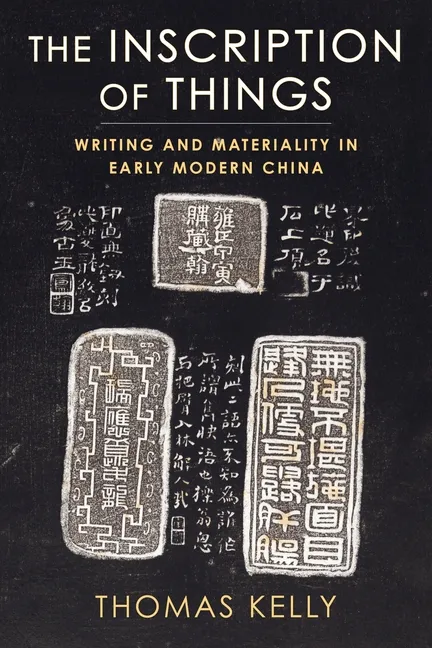
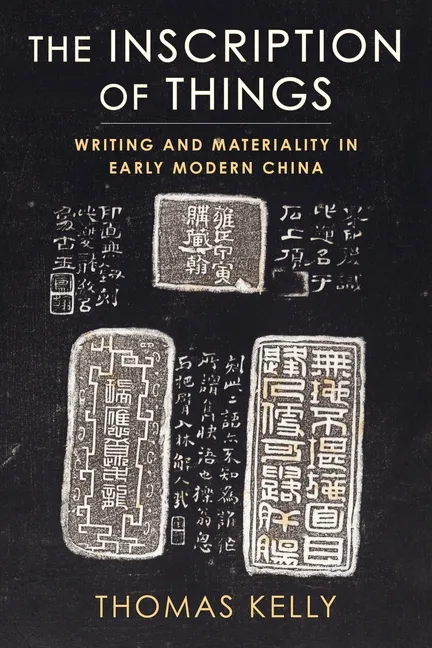
Why would an inkstone have a poem inscribed on it? Early modern Chinese writers did not limit themselves to working with brushes and ink, and their texts were not confined to woodblock-printed books or the boundaries of the paper page. Poets carved lines of verse onto cups, ladles, animal horns, seashells, walking sticks, boxes, fans, daggers, teapots, and musical instruments. Calligraphers left messages on the implements ordinarily used for writing on paper. These inscriptions—terse compositions in verse or epigrammatic prose—relate in complex ways to the objects on which they are written.
Thomas Kelly develops a new account of the relationship between Chinese literature and material culture by examining inscribed objects from the late Ming and early to mid-Qing dynasties. He considers how the literary qualities of inscriptions interact with the visual and physical properties of the things that bear them. Kelly argues that inscribing an object became a means for authors to grapple with the materiality and technologies of writing. Facing profound social upheavals, from volatility in the marketplace to the violence of dynastic transition, writers turned to inscriptions to reflect on their investments in and dependence on the permanence of the written word. Shedding new light on cultures of writing in early modern China, The Inscription of Things broadens understandings of the links between the literary and the material.
Thomas Kelly
Thomas Kelly (b. 1960) is the author of three novels set in New York City. Born in New York, Kelly spent ten years as a construction worker and sandhog—working in the subway tunnels beneath the city—before attending Fordham University and Harvard University, where he received a master’s degree in public administration. Kelly parlayed his experience in union politics into a job as an advance man for the campaign of New York City mayor David Dinkins, an experience which would form the basis for some of his fiction. Kelly began writing in the mid-1990s, and published his debut, Payback, in 1997. A gritty look at the overlap between construction and the Mafia, it was critically acclaimed and adapted to film by David Mamet. Kelly’s other works are The Rackets (2001), which was inspired by Kelly’s experience working for City Hall, and Empire Rising (2005), a historical novel about the construction of the Empire State Building.
More by Thomas Kelly










Why Readwise Books?
Readwise Books is an ebook & audiobook platform that automatically logs how much you and your friends read, making it fun and easy to read more. Learn more →