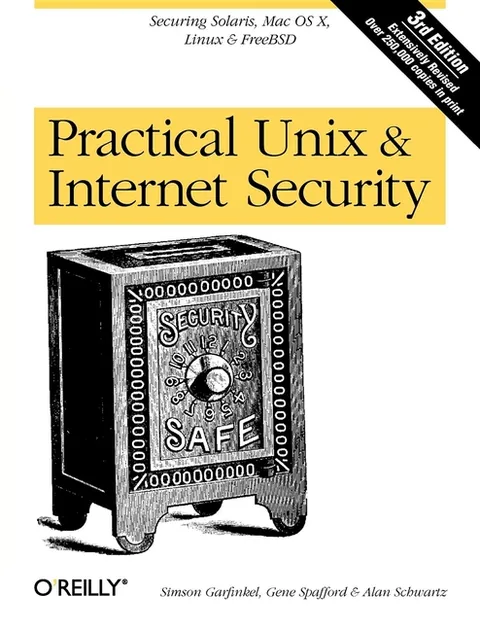
Practical Unix and Internet Security
Report an issue
Tell us what's wrong and we'll take a look.
Thanks – we got it. We'll review and follow up if needed.
When Practical Unix Security was first published more than a decade ago, it became an instant classic. Crammed with information about host security, it saved many a Unix system administrator from disaster. The second edition added much-needed Internet security coverage and doubled the size of the original volume. The third edition is a comprehensive update of this very popular book - a companion for the Unix/Linux system administrator who needs to secure his or her organization's system, networks, and web presence in an increasingly hostile world. Focusing on the four most popular Unix variants today--Solaris, Mac OS X, Linux, and FreeBSD--this book contains new information on PAM (Pluggable Authentication Modules), LDAP, SMB/Samba, anti-theft technologies, embedded systems, wireless and laptop issues, forensics, intrusion detection, chroot jails, telephone scanners and firewalls, virtual and cryptographic filesystems, WebNFS, kernel security levels, outsourcing, legal issues, new Internet protocols and cryptographic algorithms, and much more. Practical Unix & Internet Security consists of six parts:
- Computer security basics: introduction to security problems and solutions, Unix history and lineage, and the importance of security policies as a basic element of system security.
- Security building blocks: fundamentals of Unix passwords, users, groups, the Unix filesystem, cryptography, physical security, and personnel security.
- Network security: a detailed look at modem and dialup security, TCP/IP, securing individual network services, Sun's RPC, various host and network authentication systems (e.g., NIS, NIS+, and Kerberos), NFS and other filesystems, and the importance of secure programming.
- Secure operations: keeping up to date in today's changing security world, backups, defending against attacks, performing integrity management, and auditing.
- Handling security incidents: discovering a break-in, dealing with programmed threats and denial of service attacks, and legal aspects of computer security.
- Appendixes: a comprehensive security checklist and a detailed bibliography of paper and electronic references for further reading and research.

Gene Spafford
Gene Spafford, Ph.D., CISSP, is an internationally renowned scientist and educator who has been working in information security, policy, cybercrime, and software engineering for nearly two decades. He is a professor at Purdue University and is the director of CERIAS, the world's premier multidisciplinary academic center for information security and assurance. Professor Spafford and his students have pioneered a number of technologies and concepts well-known in security today, including the COPS and Tripwire tools, two-stage firewalls, and vulnerability databases. Spaf, as he is widely known, has achieved numerous professional honors recognizing his teaching, his research, and his professional service. These include being named a fellow of the AAAS, the ACM, and the IEEE; receiving the National Computer Systems Security Award; receiving the William Hugh Murray Medal of the NCISSE; election to the ISSA Hall of Fame; and receiving the Charles Murphy Award at Purdue. He was named a CISSP, honoris causa in 2000. In addition to over 100 technical reports and articles on his research, Spaf is also the coauthor of Web Security, Privacy, and Commerce, and was the consulting editor for Computer Crime: A Crimefighters Handbook (both from O'Reilly).
More by Gene Spafford
Alan Schwartz
Alan Schwartz, PhD, is a decision psychologist in the Departments of Medical Education and Pediatrics at the University of Illinois at Chicago, where he teaches decision making, leadership, and quantitative methods. His research focuses on both patient and physician decision making, including evidence-based medicine, risk perception, and the impact of life goals on utility assessment. He has received the Outstanding Paper by a Young Investigator Award from the Society for Medical Decision Making, the Ray E. Helfer Award for Innovation in Pediatric Education from the Ambulatory Pediatrics Association, and the Junior Faculty Research Award from the Midwest Society for General Internal Medicine. Dr Schwartz serves on the Board of Trustees of the Society for Medical Decision Making, and coordinates the Society's 'Teaching Medical Decision Making' interest group. He also serves on the Executive Board of the Society for Judgment and Decision Making. He has taught leadership and decision making in Brazil and Pakistan, as well as on-line to students throughout the world, and twice received his University's peer-reviewed teaching award.


Why Readwise Books?
Readwise Books is an ebook & audiobook platform that automatically logs how much you and your friends read, making it fun and easy to read more. Learn more →