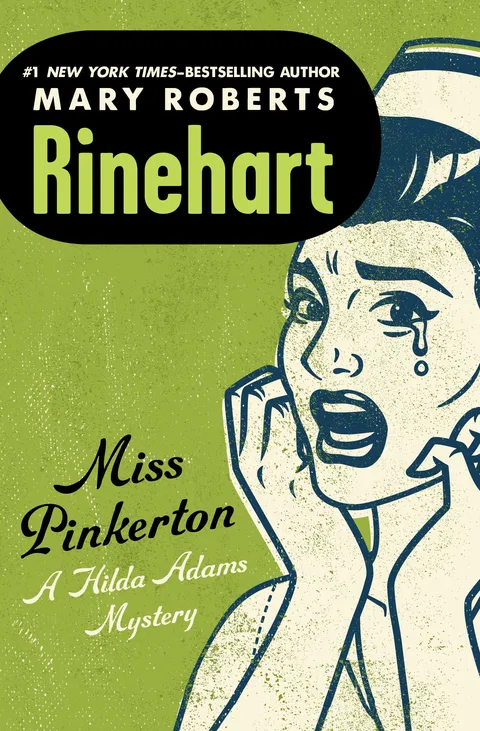
Miss Pinkerton
Report an issue
Tell us what's wrong and we'll take a look.
Thanks – we got it. We'll review and follow up if needed.
A locked-room murder keeps a nurse-turned-sleuth on guard—and will "keep the reader . . . shivering and guessing" in this Golden Age mystery (The New York Times). If the dissolute nephew of elderly Juliet Mitchell committed suicide, then why has the Homicide Squad enlisted the help of nurse Hilda Adams at the Mitchell mansion? Because Inspector Patton has his doubts about Herbert's death—even though he died by gunshot in his locked bedroom. The services of the bureau's indispensable sleuth, "Miss Pinkerton," are twofold: to care for the traumatized and bedridden Juliet, and to find out who really pulled the trigger. But Hilda's about to discover that the Mitchell family's secrets are as dark as the shadows in the creaking old house, and that there's a good reason why the servants seem gripped by an inexplicable fear. Now it's up to Miss Pinkerton to solve the case, if she can survive the night. Hailed by Carolyn Hart as a major influence, she salutes Rinehart as "the first author to write a humorous mystery with a female protagonist . . . a staple of crime fiction from then to now." This witty whodunit by the Mystery Writers of America Special Award winner was the basis for the 1932 film starring Joan Blondell.
Mary Roberts Rinehart
Mary Roberts Rinehart (1876–1958) was one of the United States’s most popular early mystery authors. Born in Pittsburgh to a clerk at a sewing machine agency, Rinehart trained as a nurse and married a doctor after her graduation from nursing school. She wrote fiction in her spare time until a stock market crash sent her and her young husband into debt, forcing her to lean on her writing to pay the bills. Her first two novels, The Circular Staircase (1908) and The Man in Lower Ten (1909), established her as a bright young talent, and it wasn’t long before she was one of the nation’s most popular mystery novelists. Among her dozens of novels are The Amazing Adventures of Letitia Carberry (1911), which began a six-book series, and The Bat (originally published in 1920 as a play), which was among the inspirations for Bob Kane’s Batman. Credited with inventing the phrase “The butler did it,” Rinehart is often called an American Agatha Christie, even though she began writing much earlier than Christie, and was much more popular during her heyday.
More by Mary Roberts Rinehart









Why Readwise Books?
Readwise Books is an ebook & audiobook platform that automatically logs how much you and your friends read, making it fun and easy to read more. Learn more →