Report an issue
Tell us what's wrong and we'll take a look.
Thanks – we got it. We'll review and follow up if needed.
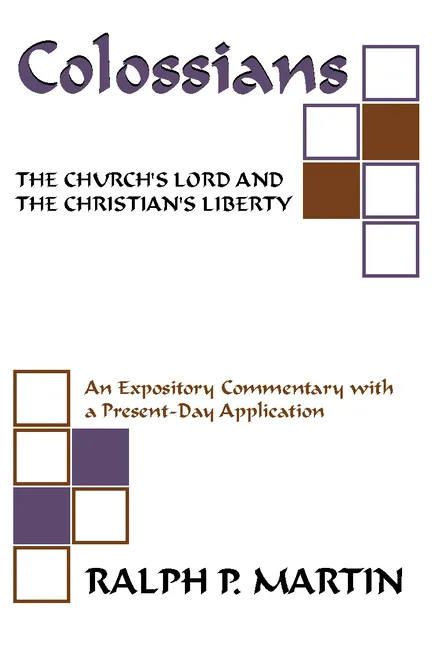
How can a letter written over 1900 years ago to a Christian group in a small town of Asia Minor mean anything to us? But if Colossians is a word from a God who does not change, and is therefore relevant to His people in every age, how are we to understand and interpret Paul's thought and expression today? Dr. Ralph Martin tackles this problem by asking what the apostle meant when he set out to instruct, correct and exhort the original readers of the epistle. From this inquiry he deduces certain principles of belief and conduct which may still be applied even though our situation differs in external details from that in which the Colossian Christians found themselves. The underlying intellectual and religious question is the same--what is man's relation to the cosmos and the powers that rule it? The predominant theme of the book, as of the epistle, is the glory and Lordship of the risen Christ, in whom Christian believers have come to fullness of life. Professor Martin examines the Colossian heresy, and shows that life in Christ brings complete liberation from mental and spiritual bondage to those merely human mystical notions that had only an appearance of wisdom. From doctrine he moves on, with Paul, to the therefore of everyday Christian conduct, in the context of family relationships, prayer, and the Church's mission in today's world. So far from being out-of-date or irrelevant, the Epistle to the Colossians might well have been written (as indeed in one sense it was!), for our modern space-age. It shows the person of Jesus Christ as the answer to humanity's questioning about the cosmos of which we form such a frighteningly insignificant part. Above all it sets out the Jesus of history as the Lord of glory, the Master of time and space, and shows the essential continuity between the two. It is Professor Martin's first aim to make the background and the message of the Epistle clear in its original setting, and then to show its particular relevance to the present day.
Ralph P Martin
Ralph P. Martin (1925-2013) was Distinguished Scholar in Residence at Fuller Theological Seminary and a New Testament Editor for the Word Biblical Commentary series. He earned the BA and MA from the University of Manchester, England, and the PhD from King's College, University of London. He was the author of numerous studies and commentaries on the New Testament, including Worship in the Early Church, the volume on Philippians in The Tyndale New Testament Commentary series. He also wrote 2 Corinthians and James in the WBC series.
More by Ralph P Martin


Why Readwise Books?
Readwise Books is an ebook & audiobook platform that automatically logs how much you and your friends read, making it fun and easy to read more. Learn more →