Report an issue
Tell us what's wrong and we'll take a look.
Thanks – we got it. We'll review and follow up if needed.
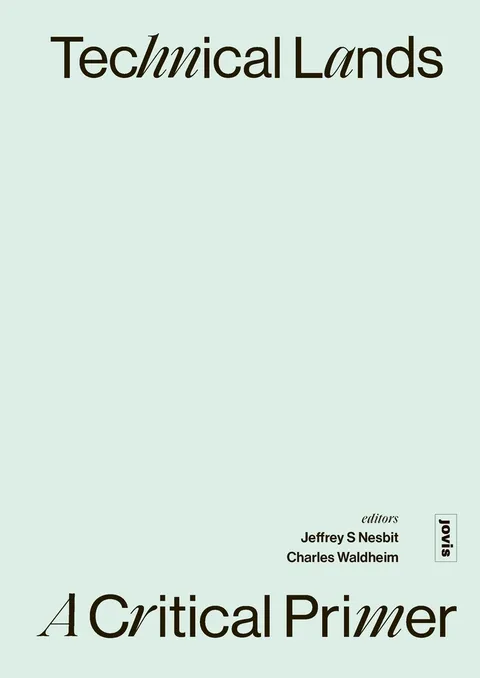
Designating land as technical is a political act. Doing so entails dividing, marginalizing, and rendering portions of the Earth inaccessible. Technical lands are co-extensive with political and physical boundaries instrumentalized by their exceptional status. Their remote location, delimited boundary, and active management occlude their visibility. Technical lands include disaster exclusion and demilitarized zones, extractive industry sites, airports, and spaceports, among dozens of other typologies. Despite the recent emergence of a discourse on technical lands, our understanding of these geographies remains unclear. Technical Lands: A Critical Primer assembles authors from a diverse array of disciplines, geographies, and epistemologies to illuminate the meanings of these spaces.
Jeffrey S Nesbit
Jeffrey S. Nesbit is an architect, urbanist, and founding director of the research group Grounding Design. He recently received his Doctor of Design degree (DDes) from Harvard University Graduate School of Design, where he was a postdoctoral research fellow in the Office for Urbanization. Nesbit's work focuses on processes of urbanization, infrastructure, and the evolution of "technical lands." His experience spanning over a decade includes leading design teams for public architecture and large-scale urban projects, along with managing sponsored design research projects for city governments, local institutions, and NGOs. Currently, his research examines the 20th-century American spaceport complex at the intersection of architecture, infrastructure, and aerospace history. Nesbit has published several journal articles, book chapters, and is editor of Nature of Enclosure (Actar, 2022), co-editor of New Geographies 11 Extraterrestrial (Actar, 2019), Rio de Janeiro: Urban Expansion and Environment (Routledge, 2019), Chasing the City: Models for Extra-Urban Investigations (Routledge, 2018), and host and producer of three podcasts series. Nesbit is Assistant Professor in History and Theory of Architecture and Urbanism at Temple University, and previously taught at several institutions, including Harvard University, Northeastern University, University of North Carolina Charlotte, University of New Mexico, and Texas Tech University.
More by Jeffrey S Nesbit
Charles Waldheim
Charles Waldheim is an architect and urbanist whose research examines the relationships between landscape, ecology, and contemporary urbanism. Waldheim is John E. Irving Professor of Landscape Architecture at the Harvard University Graduate School of Design where he directs the Office for Urbanization.
More by Charles Waldheim


Why Readwise Books?
Readwise Books is an ebook & audiobook platform that automatically logs how much you and your friends read, making it fun and easy to read more. Learn more →