Report an issue
Tell us what's wrong and we'll take a look.
Thanks – we got it. We'll review and follow up if needed.
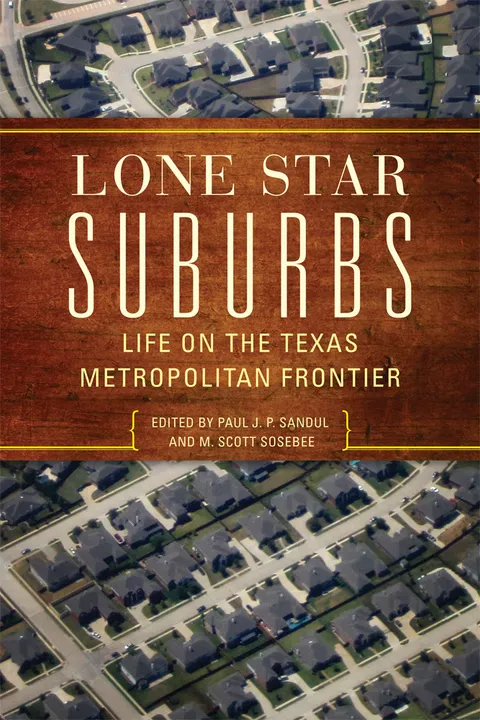
How is it that nearly 90 percent of the Texan population currently lives in metropolitan regions, but many Texans still embrace and promote a vision of their state's nineteenth-century rural identity? This is one of the questions the editors and contributors to Lone Star Suburbs confront. One answer, they contend, may be the long shadow cast by a Texas myth that has served the dominant culture while marginalizing those on the fringes. Another may be the criticism suburbia has endured for undermining the very romantic individuality that the Texas myth celebrates.
From the 1950s to the present, cultural critics have derided suburbs as landscapes of sameness and conformity. Only recently have historians begun to document the multidimensional industrial and ethnic aspects of suburban life as well as the development of multifamily housing, services, and leisure facilities. In Lone Star Suburbs, urban historian Paul J. P. Sandul, Texas historian M. Scott Sosebee, and ten contributors move the discussion of suburbia well beyond the stereotype of endless blocks of white middle-class neighborhoods and fill a gap in our knowledge of the Lone Star State.
This collection supports the claim that Texas is not only primarily suburban but also the most representative example of this urban form in the United States. Essays consider transportation infrastructure, urban planning, and professional sports as they relate to the suburban ideal; the experiences of African Americans, Asian Americans, and Latinos in Texas metropolitan areas; and the environmental consequences of suburbanization in the state.
Texas is no longer the bastion of rural life in the United States but now--for better or worse--represents the leading edge of suburban living. This important book offers a first step in coming to grips with that reality.
M Scott Sosebee
M. Scott Sosebee is a professor of history at Stephen F. Austin State University and is executive director and editor of the East Texas Historical Association. He is the co-editor (with Paul J. P. Sandul) of the anthology Lone Star Suburbs: Life on the Texas Metropolitan Frontier and the author of Henry C. "Hank" Smith and the Cross B Ranch: The First Stock Operation on the South Plains. He lives in Nacogdoches, Texas.


Why Readwise Books?
Readwise Books is an ebook & audiobook platform that automatically logs how much you and your friends read, making it fun and easy to read more. Learn more →