Report an issue
Tell us what's wrong and we'll take a look.
Thanks – we got it. We'll review and follow up if needed.
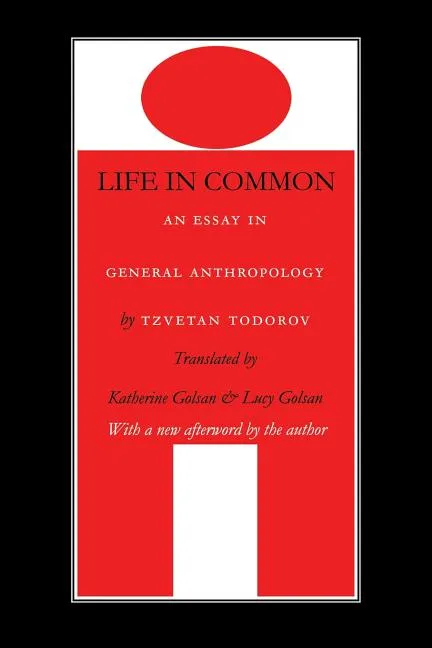
In Life in Common Tzvetan Todorov explores the construction of the self and offers new perspectives on current debates about otherness. Through the seventeenth century, solitude was considered the human condition in the Western philosophical tradition. The self was not dependent on others to perceive itself as complete. Todorov sees a reversal of this thinking beginning with the writings of Jean-Jacques Rousseau in the eighteenth century. For the first time the self was defined as incomplete without the other, and the gaze no longer served only to satisfy personal vanity but constituted the fundamental requisite for human identity. Todorov traces the far-reaching implications of Rousseau's new vision of the self and society through the political, philosophical, and psychoanalytical theories of Adam Smith, Georg Wilhelm Friedrich Hegel, Georges Bataille, Melanie Klein, and others, and the relevant literary works of Karl Philipp Moritz, the Marquis de Sade, and Marcel Proust. In an original study of the bond between parent and child, Todorov develops a compelling vision of the self as social.
Tzvetan Todorov
Tzvetan Todorov is Director of Research at the Centre National de la Recherche Scientifique in Paris. A native of Bulgaria living in France for over four decades, he is among the most influential literary and cultural theorists writing today. Among his many books available in English translation are The Fantastic: A Structural Approach to a Literary Genre, Theories of the Symbol, and Symbolism and Interpretation, all available from Cornell.
More by Tzvetan Todorov



Why Readwise Books?
Readwise Books is an ebook & audiobook platform that automatically logs how much you and your friends read, making it fun and easy to read more. Learn more →