Report an issue
Tell us what's wrong and we'll take a look.
Thanks – we got it. We'll review and follow up if needed.
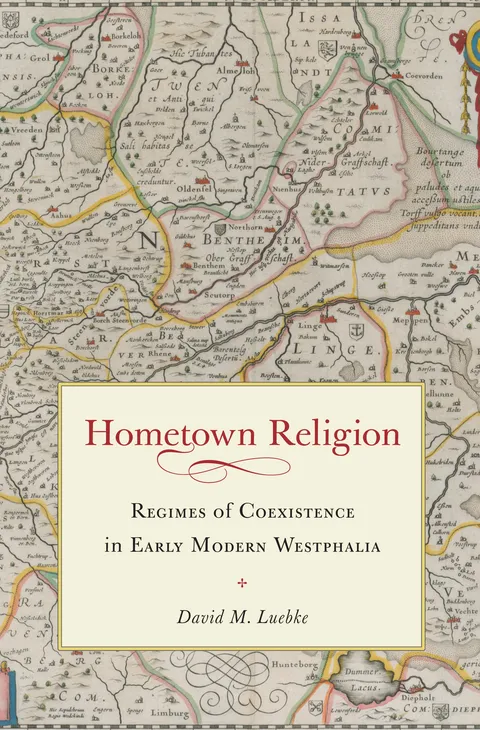
The pluralization of Christian religion was the defining fact of cultural life in sixteenth-century Europe. Everywhere they took root, ideas of evangelical reform disturbed the unity of religious observance on which political community was founded. By the third quarter of the sixteenth century, one or another form of Christianity had emerged as dominant in most territories of the Holy Roman Empire.In Hometown Religion: Regimes of Coexistence in Early Modern Westphalia, David Luebke examines a territory that managed to escape that fate—the prince-bishopric of Münster, a sprawling ecclesiastical principality and the heart of an entire region in which no single form of Christianity dominated. In this confessional "no-man’s-land," a largely peaceable order took shape and survived well into the mid-seventeenth century, a unique situation, which raises several intriguing questions: How did Catholics and Protestants manage to share parishes for so long without religious violence? How did they hold together their communities in the face of religious pluralization? Luebke responds by examining the birth, maturation, old age, and death of a biconfessional "regime"—a system of laws, territorial agreements, customs, and tacit understandings that enabled Roman Catholics and Protestants, Lutherans as well as Calvinists, to cohabit the territory’s parishes for the better part of a century.
In revealing how these towns were able to preserve peace and unity—in the Age of Religious Wars— Hometown Religion attests to the power of toleration in the conduct of everyday life.
David M. Luebke
David M. Luebke is the Katherine G. Brady & Thomas A. Brady, Jr., Roger Chickering & Alison Baker Professor of Central European Histories at the University of Oregon, USA. He is the author of Hometown Religion: Regimes of Coexistence in Early Modern Westphalia, 1535-1650 (2016), which was awarded the Gerald Strauss Prize in 2017 and His Majesty's Rebels: Communities, Factions, and Rural Revolt in the Black Forest, 1725-1745 (1997). He is also founding editor of Spektrum: Publications of the German Studies Association and series co-editor of Studies in Central European Histories.
More by David M. Luebke


Why Readwise Books?
Readwise Books is an ebook & audiobook platform that automatically logs how much you and your friends read, making it fun and easy to read more. Learn more →