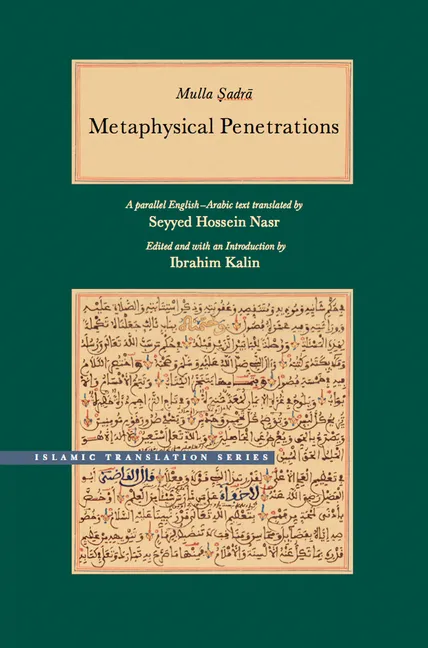
The Book of Metaphysical Penetrations
Report an issue
Tell us what's wrong and we'll take a look.
Thanks – we got it. We'll review and follow up if needed.
Mulla Sadra (ca. 1572-1640) is one of the most prominent figures of post-Avicennan Islamic philosophy and among the most important philosophers of Safavid Persia. He was a prolific writer whose work advanced the fields of intellectual and religious science in Islamic philosophy, but arguably his most important contribution to Islamic philosophy is in the study of existence (wujud) and its application to such areas as cosmology, epistemology, psychology, and eschatology. Sadra represents a paradigm shift from the Aristotelian metaphysics of fixed substances, which had dominated Islamic philosophy, to an analysis of existence as the ultimate ground and dynamic source of things. He posits that all beings derive their reality and truth from their wujud and that a proper philosophical analysis must therefore start and eventually end with it. The present work's focus on Sadra's gradational ontology provides a strong foundation for the reader to understand Sadra's other works and later texts by other philosophers working in the same field. This edition contains parallel English-Arabic texts and a new translation by preeminent scholar of Islamic philosophy Seyyed Hossein Nasr.

Seyyed Hossein Nasr
Translated by
Seyyed Hossein Nasr is university professor of Islamic Studies at George Washington University. Author of over fifty books, Professor Nasr is a well-known and highly respected intellectual figure both in the West and in the Islamic world. Born in Tehran, raised from the age of twelve in the United States, and a graduate of MIT and Harvard University, Nasr is well qualified to explain Islam to a Western audience. He appears frequently on Meet the Press, as well as other national news shows.


Why Readwise Books?
Readwise Books is an ebook & audiobook platform that automatically logs how much you and your friends read, making it fun and easy to read more. Learn more →