Report an issue
Tell us what's wrong and we'll take a look.
Thanks – we got it. We'll review and follow up if needed.
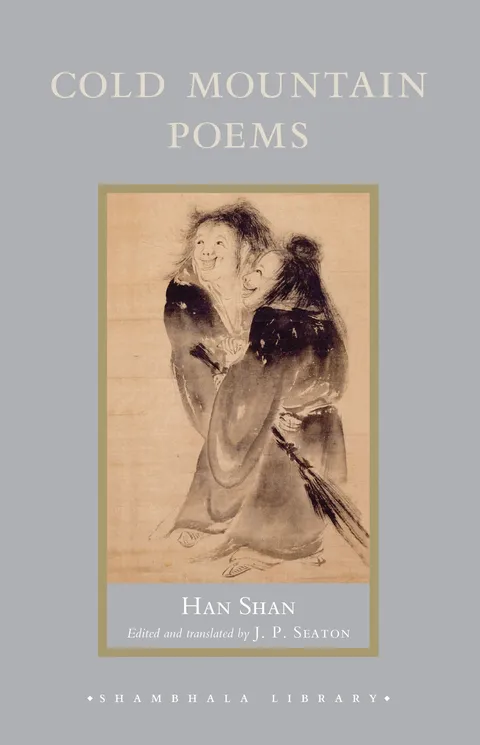
The incomparable poetry of Han Shan (Cold Mountain) and his sidekick Shih Te, the rebel poets who became icons of Chinese poetry and Zen, has long captured the imagination of poetry lovers and Zen aficionados. Popularized in the West by Beat Generation writers Gary Snyder and Jack Kerouac, these legendary T’ang era (618–907) figures are portrayed as the laughing, ragged pair who left their poetry on stones, trees, farmhouses, and the walls of the monasteries they visited. Their poetry expressed in the simplest verse but in a completely new tone, the voice of ordinary people.
Here premier translator J. P. Seaton takes a fresh look at these captivating poets, along with Wang Fan-chih, another "outsider" poet who lived a couple centuries later and who captured the poverty and gritty day-to-day reality of the common people of his time. Seaton’s comprehensive introduction and notes throughout give a fascinating context to this vibrant collection.
Hanshan
Hanshan (7th to 9th centuries) is said to have been an iconoclastic Chan/Zen Buddhist monk who dwelled alone in a cave in a rock cliff in the Tiantai Mountains. He wore a birch-bark hat and enjoyed talking to the passing clouds, playing the qin (a seven-stringed zither), and writing his poems on the rocks and walls of his mountain home. His poems were later recorded by the Song dynasty official Lu Qiuyin, who wrote in the preface to his edition, “Nobody knows where Hanshan came from.” Over three hundred poems attributed to him have survived. Jack Kerouac dedicated his novel Dharma Bums to him.
More by Hanshan



Why Readwise Books?
Readwise Books is an ebook & audiobook platform that automatically logs how much you and your friends read, making it fun and easy to read more. Learn more →