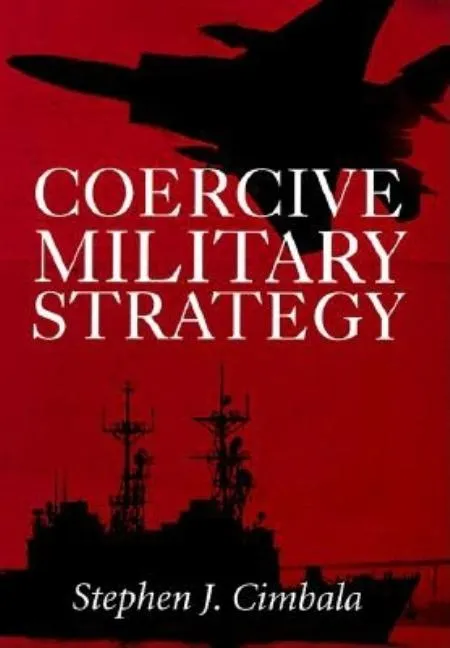
Coercive Military Strategy
Report an issue
Tell us what's wrong and we'll take a look.
Thanks – we got it. We'll review and follow up if needed.
In Coercive Military Strategy, Stephen J. Cimbala shows that coercive military strategy is a necessary part of any diplomatic-strategic recipe for success. Few wars are total wars, fought to annihilation, and military power is inherently political, employed for political purpose, in order to advance the public agenda of a state, so in any war there comes a time when a diplomatic resolution may be possible. To that end, coercive strategy should be flexible, for there are as many variations to it as there are variations in wars and warfare.
Cimbala observes several cases of applying coercive strategy in the twentieth century: the U.S. strategy of limited war during the Cold War; the Cuban Missile Crisis, in which both the United States and the Soviet Union applied coercive strategy; Desert Storm, in which the Coalition Forces could practice coercion without restraint; and the Vietnam War, in which U.S. coercive strategy was ultimately a failure.
Additionally, Cimbala examines coercion and the theory of collective security, which implies a willingness on the part of individual states, such as the NATO nations, to combine against any aspiring aggressor.
With his examples, and the arguments they illustrate, Cimbala shows that although coercive strategy is a remedy for neither the ailments of U.S. national security nor world conflict, it will become more important in peace, crisis, and even war in the next century, when winning with the minimum of force or without force will become more important than winning by means of maximum firepower.


Why Readwise Books?
Readwise Books is an ebook & audiobook platform that automatically logs how much you and your friends read, making it fun and easy to read more. Learn more →