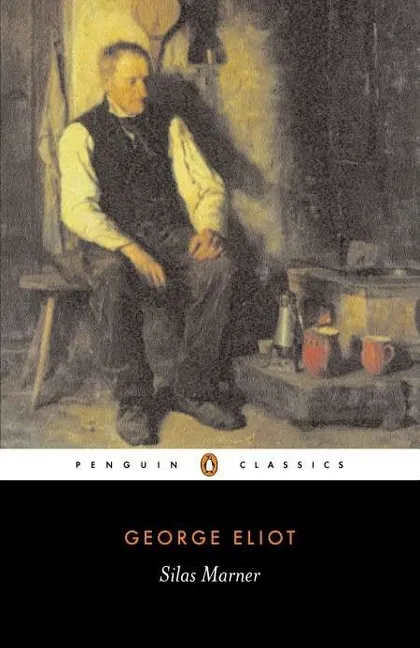
Silas Marner
Report an issue
Tell us what's wrong and we'll take a look.
Thanks – we got it. We'll review and follow up if needed.


George Eliot's tale of a solitary miser gradually redeemed by the joy of fatherhood, Silas Marner is edited with an introduction and notes by David Carroll in Penguin Classics. Wrongly accused of theft and exiled from a religious community many years before, the embittered weaver Silas Marner lives alone in Raveloe, living only for work and his precious hoard of money. But when his money is stolen and an orphaned child finds her way into his house, Silas is given the chance to transform his life. His fate, and that of Eppie, the little girl he adopts, is entwined with Godfrey Cass, son of the village Squire, who, like Silas, is trapped by his past. Silas Marner, George Eliot's favourite of her novels, combines humour, rich symbolism and pointed social criticism to create an unsentimental but affectionate portrait of rural life. This text uses the Cabinet edition, revised by George Eliot in 1878. David Carroll's introduction is complemented by the original Penguin Classics edition introduction by Q.D. Leavis. Mary Ann Evans (1819-80) began her literary career as a translator, and later editor, of the Westminster Review. In 1857, she published Scenes of Clerical Life, the first of eight novels she would publish under the name of 'George Eliot', including The Mill on the Floss, Middlemarch, and Daniel Deronda. If you enjoyed Silas Marner, you might like Nathaniel Hawthorne's The Scarlet Letter, also available in Penguin Classics. 'I think Silas Marner holds a higher place than any of the author's works. It is more nearly a masterpiece; it has more of that simple, rounded, consummate aspect ... which marks a classical work' Henry James
George Eliot
George Eliot (1819–1880) was the pseudonym of Mary Ann Evans, one of the defining authors of the Victorian era, who penned influential works such as Adam Bede, Middlemarch, The Mill on the Floss, and Silas Marner. Eliot began her career by writing for local newspapers, eventually running the Westminster Review. During her time there, she decided to become a novelist and chose a masculine pen name in order to avoid the rampant sexism of the day. Her first novel, Adam Bede, was an instant success. Eliot’s realist philosophy and deep characterizations were defining features of her work, and her classic novels have earned her praise as one of the English language’s top authors.
More by George Eliot















Why Readwise Books?
Readwise Books is an ebook & audiobook platform that automatically logs how much you and your friends read, making it fun and easy to read more. Learn more →