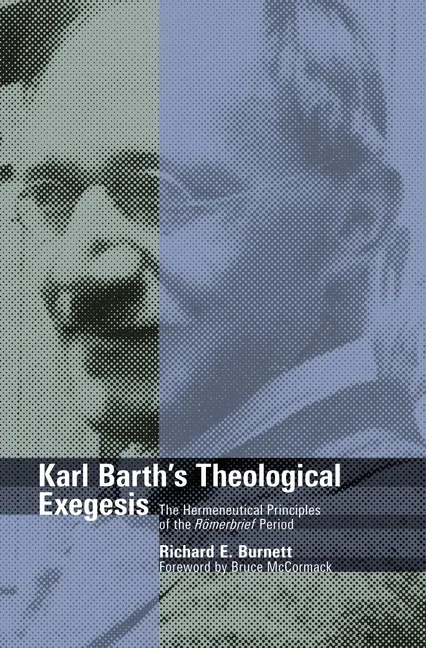
Karl Barth's Theological Exegesis
The Hermeneutical Principles of the Romerbrief Period
Report an issue
Tell us what's wrong and we'll take a look.
Thanks – we got it. We'll review and follow up if needed.
As Burnett explains, the crux of Barth's legacy is his abandonment of the hermeneutical tradition of Schleiermacher, which had had such a profound influence on Christian thought in the nineteenth and twentieth centuries. This hermeneutical tradition, which began with Herder and extended through Dilthey, Troeltsch, Wobbermin, Wernle, and Barth himself prior to 1915, is characterized by its attempt to integrate broad aspects of interpretation, to establish universally valid rules of interpretation on the basis of a general anthropology, and by its reliance on empathy.
Barth's discovery that "the being of God is the hermeneutical problem" implied that the object to be known should determine the way taken in knowing. This fundamental insight brought about a hermeneutical revolution that gave priority to content over method, to actual exegesis over hermeneutical theory. The development of Barth's new approach to Scripture is especially evident in his Römerbrief period, during which he developed a set of principles for properly reading Scripture. Burnett focuses on these principles, which have never been discussed at length or viewed specifically in relationship to Schleiermacher, and presents a study that challenges both "neo-orthodox" and "postmodern" readings of Barth.
This is a crucial piece of scholarship. Not only is it the first major book in English on Barth's hermeneutics, but it also employs pioneering research in Barth studies. Burnett includes in his discussion important material only recently discovered in Switzerland and made available here in English for the first time -- namely, six preface drafts that Barth wrote for his famous Romans commentary, which some regard as the greatest theological work of all time.
In making a major contribution to Barth studies, this volume will also inform scholars, pastors, and students whose interests range from modern Christian theology to the history of biblical interpretation.
Richard E Burnett
Professor of Systematic Theology at Erskine Theological Seminary in Due West, SC.
More by Richard E Burnett


Why Readwise Books?
Readwise Books is an ebook & audiobook platform that automatically logs how much you and your friends read, making it fun and easy to read more. Learn more →