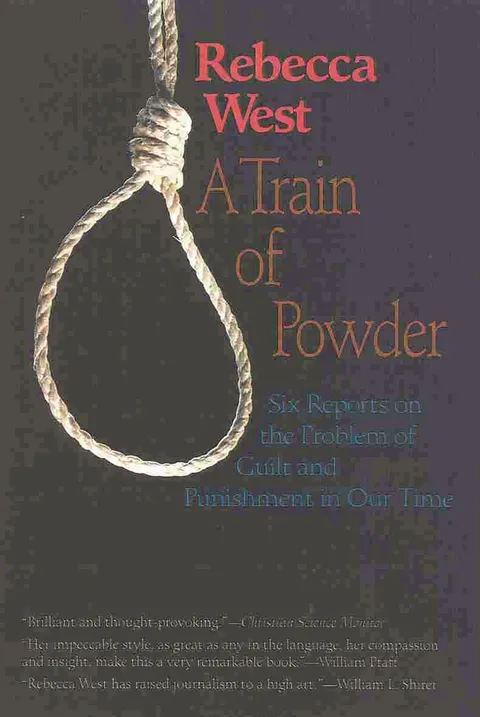
Train of Powder
Report an issue
Tell us what's wrong and we'll take a look.
Thanks – we got it. We'll review and follow up if needed.
Like most all of Rebecca West's reportage, A Train of Powder approaches great literature. Written between 1946 and 1954, these accounts of four controversial trials explore the nature of crime and punishment, innocence and guilt, retribution and forgiveness. The centerpiece of the book is "Greenhouse with Cyclamens," a three-part essay on the Nuremberg trials written with precision, clarity, and daring insight. She also reports on two particularly brutal murder trials - one for a lynching in North Carolina, the other for a "torso murder" in England - and the espionage trial of a British telegrapher. Throughout, the question of guilt inspires Ms. West to feats of psychological detection wherein unerring craftsmanship and a powerful narrative sense combine to a high purpose - the pursuit of truth. "An astonishing book.... As compelling as Court TV but without the frisson of voyeurism (and with the compensatory satisfactions of West's breathtakingly lucid prose style), these elegant narratives remind us of the preciousness and fragility of our right to trial by jury."-Francine Prose. "It is her unique magic to combine impressionism and precision, as if Monet and Ingres could somehow be fused. Time and again a passage begins as a sort of iridescent cloud, and culminates in a diamond point."-Telford Taylor, Saturday Review. "Rebecca West...has raised journalism to a high art, breathing into it a depth, a poetry, a subtlety, and an understanding and compassion for human beings and their endless follies and tragedies that give it a legitimate place in contemporary literature."-William L. Shirer.
Rebecca West
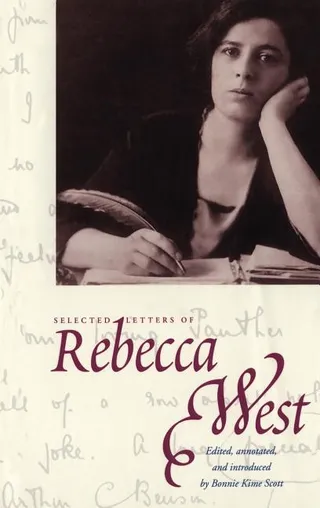
Rebecca West was a British author, journalist, literary critic, and travel writer. West, a novelist who worked in a variety of genres, reviewed books for The Times, the New York Herald Tribune, The Sunday Telegraph, and The New Republic, as well as serving as a Bookman correspondent. Rebecca West was born Cicily Isabel Fairfield in London, England, in 1892, and grew up in an environment rich in intellectual stimulation, political debate, vibrant conversation, books, and music. Her Scottish mother, Isabella, was a talented pianist who did not pursue a musical career after marrying Charles Fairfield. He never returned to them, dying poor and alone in a boarding house in Liverpool in 1906, when Cicily was 14. The rest of the family went to Edinburgh, Scotland, where Cicily attended George Watson's Ladies College. She had to leave school in 1907 because of illness.She elected not to return after recuperating from the sickness, later describing her time at Watson's as "prison".
More by Rebecca West



Why Readwise Books?
Readwise Books is an ebook & audiobook platform that automatically logs how much you and your friends read, making it fun and easy to read more. Learn more →