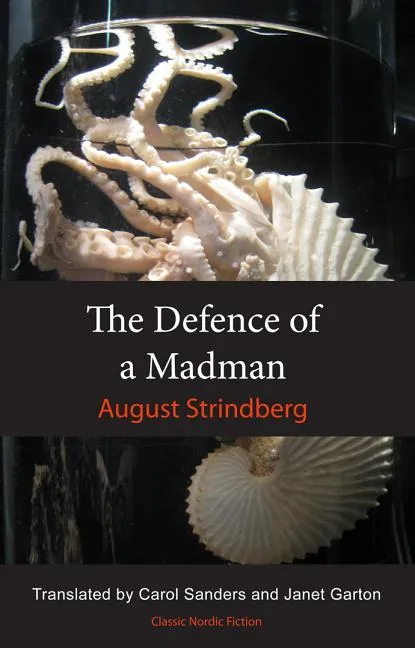
The Defence of a Madman
Report an issue
Tell us what's wrong and we'll take a look.
Thanks – we got it. We'll review and follow up if needed.
This autobiographical novel is based on Strindberg's life in the 1870s and 1880s, and focuses on his marriage to Siri von Essen. It purports to be a vehicle for explaining to himself his role in the relationship from its ecstatic beginnings to its catastrophic conclusion. Strindberg was writing at the time of the modern women's movement and the intense Nordic debate on sexual morality, and the novel echoes on an anguished personal level the theme of the battle of the sexes. It is one of his many and varied attempts to write his own life, to use himself as raw material. The novel was written in French and published as Le Plaidoyer d'un Fou in 1895. However, the French editor had made radical alterations to Strindberg's text - how radical was not discovered until 1973, when the original manuscript came to light. Previous translations into English have been made from the published French version or the Swedish translation of it; this is the first translation of Strindberg's original text.
August Strindberg
August Strindberg (1849-1912) was a Swedish playwright, novelist, poet, essayist, and painter, considered one of the most influential figures in Scandinavian literature and modern drama. His works are characterized by their exploration of psychological complexity, naturalism, and symbolism, often challenging conventional norms and exploring existential themes. Born in Stockholm, Sweden, Strindberg began his career as a journalist and writer, initially gaining recognition for his early novels and short stories. However, it was his contributions to drama that solidified his reputation. Strindberg's plays, such as "Miss Julie" (1888), "The Father" (1887), and "A Dream Play" (1902), are renowned for their intense psychological realism and innovative narrative techniques. He is credited with pioneering techniques in modernist theater and influencing playwrights and directors worldwide. Beyond drama, Strindberg's literary output includes novels, essays, poetry, and autobiographical works. His novels, like "The Red Room" (1879) and "The People of Hemsö" (1887), reflect his interest in naturalism and social criticism, often depicting the struggles of individuals against societal constraints. Strindberg's writing also reflects his tumultuous personal life and evolving philosophical outlook, which ranged from skepticism and naturalism to mysticism and expressionism. His exploration of themes such as identity, madness, gender roles, and the human condition continues to resonate with readers and scholars alike. In addition to his literary pursuits, Strindberg was a prolific painter and photographer, exploring symbolism and expressionism in visual art. His multifaceted creativity and intellectual curiosity have left a lasting legacy, making him a central figure in the development of modern literature and theater. August Strindberg's works continue to be studied and performed worldwide, celebrated for their profound insight into the complexities of human relationships and the existential dilemmas of modern life.
More by August Strindberg



Carol Sanders
Translated by
Carol Sanders is Professor of French at the University of Surrey.
Janet Garton
Translated by
Janet Garton is a Senior Lecturer in Scandinavian Studies at the University of East Anglia. Janet Garton's other publications include "Writers and Politics in Modern Scandinavia" (1978) and "Jens Bjorneboe: Prophet without Honor" (1985).


Why Readwise Books?
Readwise Books is an ebook & audiobook platform that automatically logs how much you and your friends read, making it fun and easy to read more. Learn more →