Report an issue
Tell us what's wrong and we'll take a look.
Thanks – we got it. We'll review and follow up if needed.
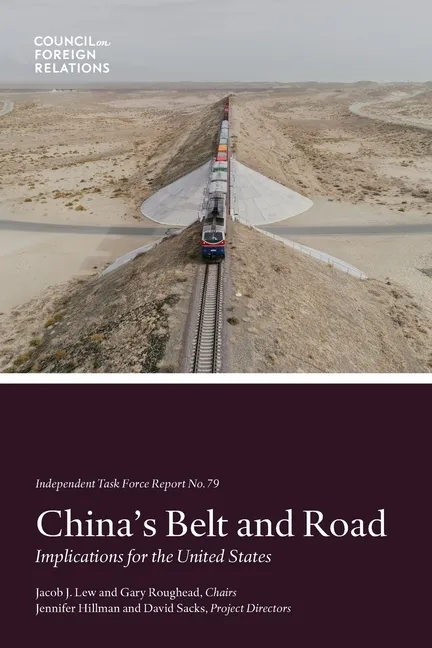
China's massive, globe-spanning Belt and Road Initiative (BRI) seeks to build everything from railways, ports, and power plants to telecommunications infrastructure and fiber-optic cables. Chinese President Xi Jinping's signature foreign policy endeavor, BRI has the potential to meet developing countries' needs and spur economic growth, but its implementation creates risks that outweigh its benefits. Unless the United States offers an effective alternative, China could reorient global trade networks, set technical standards that would disadvantage non-Chinese companies, lock countries into carbon-intensive power generation, increase its political influence over countries, and acquire power projection capabilities for its military. The COVID-19 pandemic has made a U.S. response more urgent as the global economic contraction has accelerated the reckoning with BRI-related debt. China's Belt and Road: Implications for the United States proposes that the United States respond to BRI by putting forward an affirmative agenda of its own, drawing on its strengths and coordinating with allies and partners to promote sustainable, secure, and green development.


David Sacks
David Sacks is a licensed clinical psychologist and a consultant for athletes and other elite performers. He is a graduate of Stanford University (B.A. English; M.A. Education), where he was also captain of the wrestling team. He earned his Ph.D. from Florida State University in 2003 and completed his psychology internship and postdoctoral fellowship at the Vanderbilt University Counseling Center. As a scientist-practitioner, David has published numerous articles and presented at national and international conferences.
More by David Sacks



Why Readwise Books?
Readwise Books is an ebook & audiobook platform that automatically logs how much you and your friends read, making it fun and easy to read more. Learn more →