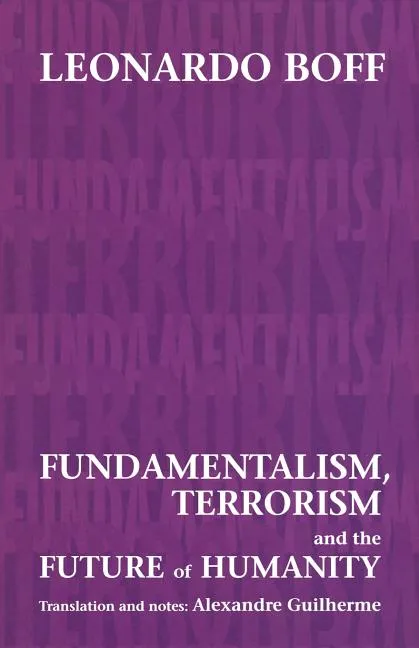
Fundamentalism, Terrorism and the Future of Humanity
Report an issue
Tell us what's wrong and we'll take a look.
Thanks – we got it. We'll review and follow up if needed.
Fundamentalism is a significant topic for our times. Islamic extremism has been blamed for the tragic events of September 11th 2001, and for the more recent bombings in London. In Fundamentalism, Terrorism and the Future of Humanity, Leonardo Boff seeks to understand and explain the phenomenon of fundamentalism, and to identify its causes and possible solutions. He concentrates not only on Islamic extremism, but the other forms of fundamentalism found in the 21st Century: Protestant and Roman Catholic fundamentalisms, and neo-liberal and technical-scientific fundamentalisms. His argument has an ethical and political dimension, and also looks at the new threat: the globalization of the enemy. "Boff challenges the Western political and religious establishment with an honest assessment and insightful analysis of the issues." Marcella Maria Althaus-Reid, Professor of Contextual Theology, University of Edinburgh
Leonardo Boff
Leonardo Boff was born in Brazil in 1938 and received a doctorate from the University of Munich in Germany in 1970. For the following twenty years, he worked as Professor of Theology at the Franciscan School for Philosophy and Theology in Petropolis, Brazil. During the 1970s, he and Gustavo Gutierrez helped to define liberation theology. Since 1993 he has been a professor at the State University of Rio de Janeiro, where he is now Emeritus Professor of Ethics, Philosophy of Religion, and Ecology. He is also a member of the international Earth Charter Commission. Boff is the author of more than seventy books, including Saint Joseph: The Father of Jesus in a Fatherless Society (Cascade Books, 2009) and Virtues: For Another Possible World (Cascade Books, 2010). In 2001 he was awarded the Right Livelihood Award (which is considered to be the "alternative" Nobel Prize) by the Swedish Parliament.
More by Leonardo Boff










Why Readwise Books?
Readwise Books is an ebook & audiobook platform that automatically logs how much you and your friends read, making it fun and easy to read more. Learn more →