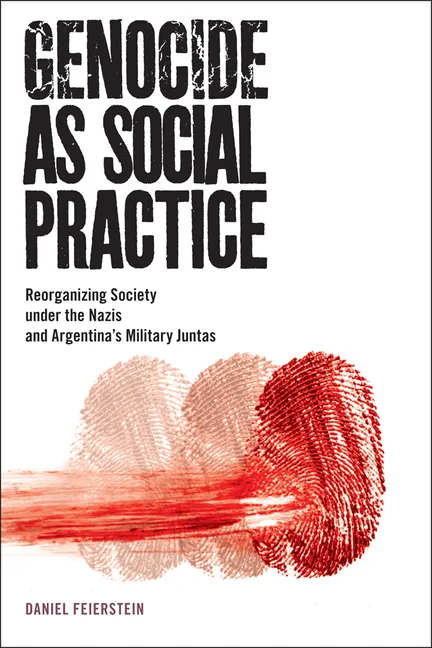
Genocide as Social Practice
Reorganizing Society Under the Nazis and Argentina's Military Juntas
Report an issue
Tell us what's wrong and we'll take a look.
Thanks – we got it. We'll review and follow up if needed.
The Nazis resorted to ruthless methods in part to stifle dissent but even more importantly to reorganize German society into a Volksgemeinschaft, or people's community, in which racial solidarity would supposedly replace class struggle. The situation in Argentina echoes this. After seizing power in 1976, the Argentine military described its own program of forced disappearances, torture, and murder as a "process of national reorganization" aimed at remodeling society on "Western and Christian" lines.
For Feierstein, genocide can be considered a technology of power--a form of social engineering--that creates, destroys, or reorganizes relationships within a given society. It influences the ways in which different social groups construct their identity and the identity of others, thus shaping the way that groups interrelate. Feierstein establishes continuity between the "reorganizing genocide" first practiced by the Nazis in concentration camps and the more complex version--complex in terms of the symbolic and material closure of social relationships --later applied in Argentina. In conclusion, he speculates on how to construct a political culture capable of confronting and resisting these trends.
First published in Argentina, in Spanish, Genocide as Social Practice has since been translated into many languages, now including this English edition. The book provides a distinctive and valuable look at genocide through the lens of Latin America as well as Europe.
Download open access ebook here.


Why Readwise Books?
Readwise Books is an ebook & audiobook platform that automatically logs how much you and your friends read, making it fun and easy to read more. Learn more →