Report an issue
Tell us what's wrong and we'll take a look.
Thanks – we got it. We'll review and follow up if needed.
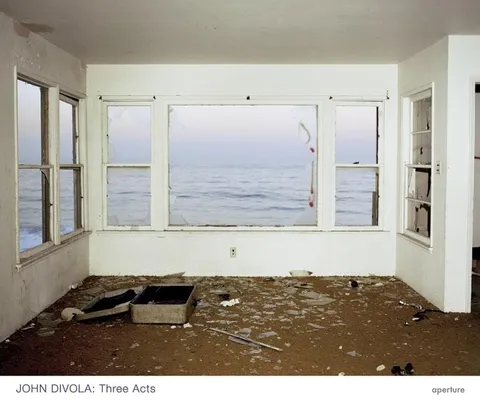
In 1973, California artist John Divola began the first of three highly ambitious and original bodies of work that form Three Acts, the first book dedicated to them. His Vandalism series comprises black-and-white photographs of interiors of abandoned houses. Entering illegally, Divola spray-painted markings that referenced action painting as readily as the graffiti that was then becoming a cultural phenomenon. For the following year's Los Angeles International Airport Noise Abatement series, he photographed a condemned neighborhood bought out to serve as a noise buffer for new runways, focusing on evidence of previous unsanctioned entries by other vandals. His final work, Zuma, documents the destruction of an abandoned beachfront property by the artist and others, as it deteriorates frame by frame and eventually burns. Divola has much in common with artists such as Bruce Nauman and Robert Smithson who have used photography to investigate other topics. He describes his innovative practice succinctly: "My acts, my painting, my photographing, my considering, are part of, not separate from, this process of evolution and change. My participation was not so much one of intellectual consideration as one of visceral involvement."
David Campany
David Campany is a curator, writer, educator, and the creative director of the International Center of Photography in New York City. His many books include Anastasia Samoylova: Adaptation, Louis Stettner, and Weegee: Society of the Spectacle, among others.


Why Readwise Books?
Readwise Books is an ebook & audiobook platform that automatically logs how much you and your friends read, making it fun and easy to read more. Learn more →