Report an issue
Tell us what's wrong and we'll take a look.
Thanks – we got it. We'll review and follow up if needed.
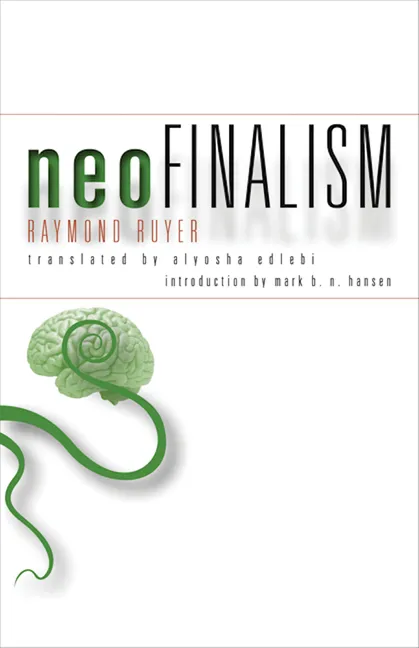
Although little known today, Raymond Ruyer was a post-World War II French philosopher whose works and ideas were significant influences on major thinkers, including Deleuze, Guattari, and Simondon. With the publication of this translation of Neofinalism, considered by many to be Ruyer's magnum opus, English-language readers can see at last how this seminal mind allied philosophy with science.
Unfazed by the idea of philosophy ending where science began, Ruyer elaborated a singular, nearly unclassifiable metaphysics and reactivated philosophy's capacity to reflect on its canonical questions: What exists? How are we to account for life? What is the status of subjectivity? And how is freedom possible? Ha
Neofinalism offers a systematic and lucidly argued treatise that deploys the innovative concepts of self-survey, form, and absolute surface to shape a theory of the virtual and the transspatial. It also makes a compelling plea for a renewed appreciation of the creative activity that organizes spatiotemporal structures and makes possible the emergence of real beings in a dynamic universe.
Raymond Ruyer
Raymond Ruyer (1902–1987) was professor of philosophy at the Université de Nancy. A highly original and prolific philosopher, he sought to provide a metaphysics adequate to the discoveries of science. Today his works are being rediscovered by a new generation, both in France and beyond. Cybernetics and the Origin of Information is his third book to appear in English translation, after Neofinalism and The Genesis of Living Forms. Amélie Berger-Soraruff is research project manager at the Maison Française d’Oxford.
More by Raymond Ruyer



Why Readwise Books?
Readwise Books is an ebook & audiobook platform that automatically logs how much you and your friends read, making it fun and easy to read more. Learn more →