Report an issue
Tell us what's wrong and we'll take a look.
Thanks – we got it. We'll review and follow up if needed.
Christian parables have retained their force well beyond the sphere of religion; indeed, they share with much of modern literature their status as a form of address: "Who hath ears to hear, let him hear." There is no message without there first being--or, more subtly, without there also being in the message itself--an address to a capacity or an aptitude for listening. This is not an exhortation of the kind "Pay attention!" Rather, it is a warning: if you do not understand, the message will go away.
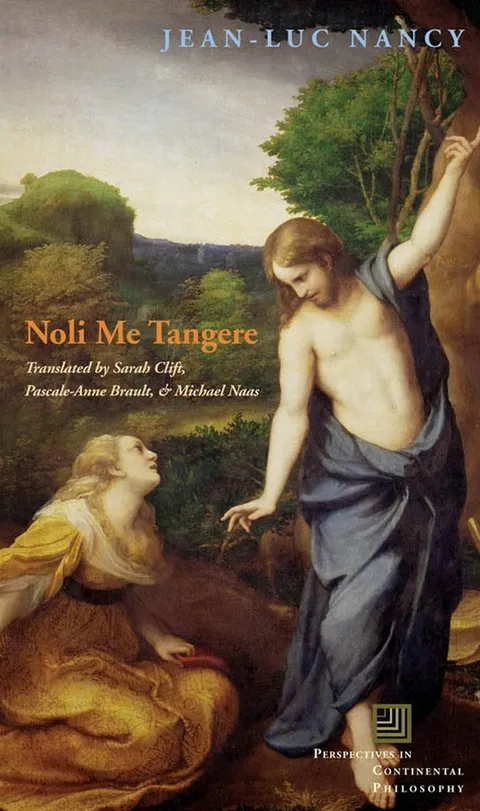
The scene in the Gospel of John in which the newly risen Christ enjoins the Magdalene, "Noli me tangere," a key moment in the general parable made up of his life, is a particularly good example of this sudden appearance in which a vanishing plays itself out. Resurrected, he speaks, makes an appeal, and leaves.
"Do not touch me." Beyond the Christ story, this everyday phrase says something important about touching in general. It points to the place where touching must not touch in order to carry out its touch (its art, its tact, its grace).
The title essay of this volume is both a contribution to Nancy's project of a "deconstruction of Christianity" and an exemplum of his remarkable writings on art, in analyses of "Noli me tangere" paintings by such painters as Rembrandt, Dürer, Titian, Pontormo, Bronzino, and Correggio. It is also in tacit dialogue with Jacques Derrida's monumental tribute to Nancy's work in Le toucher--Jean-Luc Nancy.
For the English-language edition, Nancy has added an unpublished essay on the Magdalene and the English translation of "In Heaven and on the Earth," a remarkable lecture he gave in a series designed to address children between six and twelve years of age. Closely aligned with his entire project of "the deconstruction of Christianity, '" this lecture may give the most accesible account of his ideas about God.
Jean-Luc Nancy
Jean-Luc Nancy (1940-2021) was Distinguished Professor of Philosophy at the Université de Strasbourg and one of the late twentieth and early twenty-first century's foremost thinkers of politics, art, and the body. His wide-ranging thought runs through many books, including Being Singular Plural, The Ground of the Image, Corpus, The Disavowed Community, and Sexistence. His book The Intruder was adapted into an acclaimed film by Claire Denis.
More by Jean-Luc Nancy

Sarah Clift
Translated by
Sarah Clift is Assistant Professor of Contemporary Studies at the University of King's College, Halifax.
Pascale-Anne Brault
Translated by
Pascale-Anne Brault is Professor of French at DePaul University. She is the translator of fifteen books by Jacques Derrida, Barbara Cassin, and others, and is Director of the Derrida Library series at Editions du Seuil.
Michael Naas
Translated by
Michael Naas is Professor of Philosophy at DePaul University. His most recent book is Threshold Phenomena: Derrida and the Question of Hospitality (2024). He is also the translator of twelve books by Jacques Derrida, Jean-François Lyotard, and Jean-Luc Nancy.


Why Readwise Books?
Readwise Books is an ebook & audiobook platform that automatically logs how much you and your friends read, making it fun and easy to read more. Learn more →