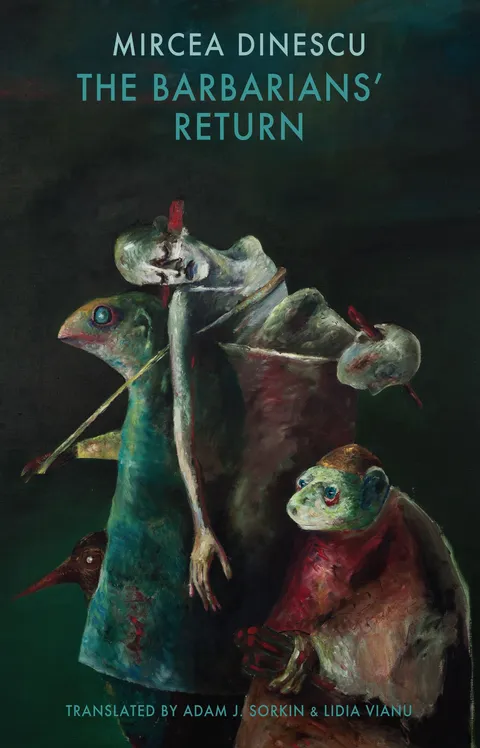
The Barbarians' Return
Report an issue
Tell us what's wrong and we'll take a look.
Thanks – we got it. We'll review and follow up if needed.
For the past 50 years, Mircea Dinescu has been one of Romanian poetry’s most provocative and obstinately singular poets. After starting out as a love poet, or so he thought, he was surprised to discover that he had created a poetry of sly political allusion. He was like that communist worker in a factory producing bicycle parts who steals a tiny wheel one day; another time, a few nuts and bolts; then taking home a chain and a length of pipe; until finally realising that however he assembled these parts, instead of a bicycle the result was a Russian machine gun. The dictator at whom Dinescu shot his metaphors was eventually was eventually shot with real bullets by his own henchmen. Unlike Dinescu, those men were able to see the difference between a bicycle and a machine gun: later on, disguising themselves as anti-communists, they pedalled their bicycles into the brave new consumer society. A quarter of a century and more since the fall of communism, Mircea Dinescu still hesitates to think of himself as witness, judge or defendant. Like an agile monkey, he jumps into and out of the handbook of literature, just as into and out of the handbook of history, where he is mentioned on page 16, in the chapter entitled Revolutions. In December 1989, Dinescu was liberated from house arrest by a large crowd in Bucharest who carried him triumphantly to the national television building. There he announced to his country and the world, with actor Ion Caramitru, that the dictator had fled. The country changed almost overnight from communist to capitalist, but Dinescu carried on doing what he’d always done: writing necessary poems that challenge all systems.
Mircea Dinescu
Mircea Dinescu is one of Romania’s leading poets. By the late 1980s he and his work were seen as controversial and confrontational, and his final book before the revolution of 1989 could only be published abroad. In 1989 he was liberated from house arrest by a large crowd in Bucharest who carried him triumphantly to the national television building. There he announced to his country and the world that the dictator had fled. Since then he has avoided compromising himself by writing for a satirical political magazine, has mocked at history by starring in a gastronomic TV show called Politics and Delicatessen, raised goats and set up his own personal winery.
Lidia Vianu
Translated by
Lidia Vianu, a poet, novelist, critic, and translator, is Professor of Modernist and Contemporary British Literature at the University of Bucharest, where she is also Director of the publishing house Contemporary Literature Press (http://mttlc.ro) and of the eZine Translation Café. She has been Fulbright professor at the University of California Berkeley and SUNY Binghamton. Vianu has published over 20 books of literary criticism, including The AfterMode and T.S. Eliot: An Author for All Seasons. She has also published several English learning manuals, and has translated over 70 books into English and Romanian, including two translated with Adam J. Sorkin and published by Bloodaxe, Marin Sorescu’s The Bridge (2004), winner of the 2005 Corneliu M. Popescu Prize for European Poetry Translation, and Mircea Dinescu's The Barbarians' Return (2018). She has published both in Romania and abroad: see Censorship in Romania (Central European University Press, 1997).


Why Readwise Books?
Readwise Books is an ebook & audiobook platform that automatically logs how much you and your friends read, making it fun and easy to read more. Learn more →