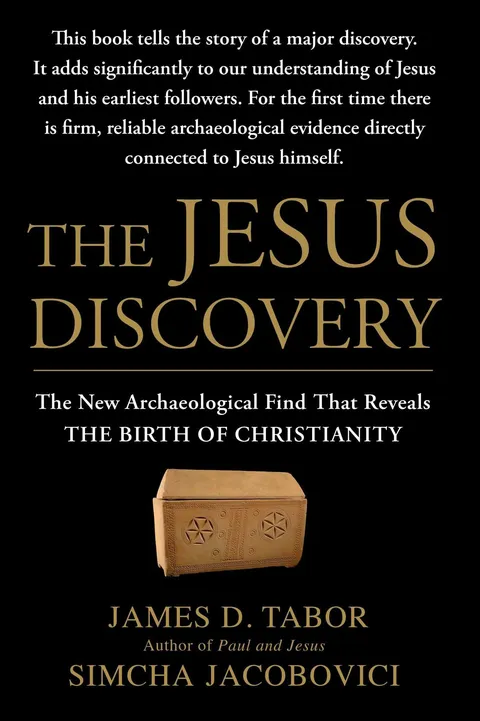
The Jesus Discovery
The Resurrection Tomb that Reveals the Birth of Christianity
Report an issue
Tell us what's wrong and we'll take a look.
Thanks – we got it. We'll review and follow up if needed.
The Jesus Discovery shows how a recent major archeological discovery in Jerusalem is revolutionizing our understanding of Jesus and the earliest years of Christianity.
The Jesus Discovery is the story of a stunning new discovery that provides the first physical evidence of Christians in Jerusalem during the time of Jesus and his apostles.
In 2010, using a specialized robotic camera, authors Tabor and Jacobovici explored a previously unexcavated tomb in Jerusalem from around the time of Jesus. They made a remarkable discovery—two ossuaries, or bone boxes, one carved with the earliest known image of Jonah; the other displaying a reference to resurrection. Since the newly discovered ossuaries can be reliably dated to before 70 AD, it is possible that whoever was buried in this tomb knew Jesus and heard him preach. In addition, the newly examined tomb is in close proximity to the so-called Jesus Family Tomb, and its discovery increases the likelihood that the “Jesus Family Tomb” is, indeed, the real tomb of Jesus of Nazareth.
James D. Tabor
James D. Tabor is Professor of Religious Studies at the University of North Carolina at Charlotte and the coauthor of A Noble Death: Suicide and Martyrdom in Antiquity (1992). Eugene V. Gallagher is Professor of Religious Studies at Connecticut College and the author of Expectation and Experience: Explaining Religious Conversion (1990).
More by James D. Tabor







Why Readwise Books?
Readwise Books is an ebook & audiobook platform that automatically logs how much you and your friends read, making it fun and easy to read more. Learn more →