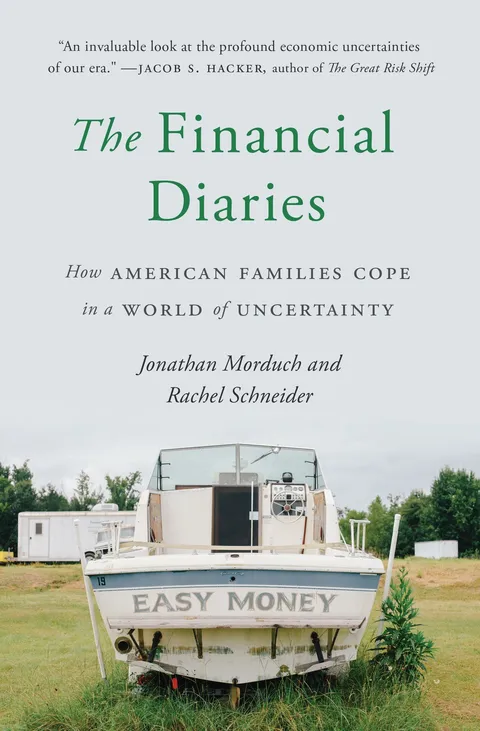
The Financial Diaries
How American Families Cope in a World of Uncertainty
Report an issue
Tell us what's wrong and we'll take a look.
Thanks – we got it. We'll review and follow up if needed.

What the financial diaries of working-class families reveal about economic stresses, why they happen, and what policies might reduce them
Deep within the American Dream lies the belief that hard work and steady saving will ensure a comfortable retirement and a better life for one's children. But in a nation experiencing unprecedented prosperity, even for many families who seem to be doing everything right, this ideal is still out of reach.
In The Financial Diaries, Jonathan Morduch and Rachel Schneider draw on the groundbreaking U.S. Financial Diaries, which follow the lives of 235 low- and middle-income families as they navigate through a year. Through the Diaries, Morduch and Schneider challenge popular assumptions about how Americans earn, spend, borrow, and save—and they identify the true causes of distress and inequality for many working Americans.
We meet real people, ranging from a casino dealer to a street vendor to a tax preparer, who open up their lives and illustrate a world of financial uncertainty in which even limited financial success requires imaginative—and often costly—coping strategies. Morduch and Schneider detail what families are doing to help themselves and describe new policies and technologies that will improve stability for those who need it most.
Combining hard facts with personal stories, The Financial Diaries presents an unparalleled inside look at the economic stresses of today's families and offers powerful, fresh ideas for solving them.
Jonathan J Morduch
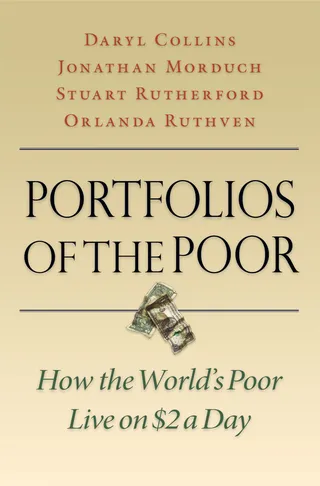
Jonathan Morduch is Professor of Public Policy and Economics at New York University's Wagner Graduate School of Public Service. Jonathan focuses on innovations that expand the frontiers of finance and how financial markets shape economic growth and inequality. Jonathan has lived and worked in Asia, but his newest book, The Financial Diaries: How American Families Cope in a World of Uncertainty (written with Rachel Schneider and published by Princeton University Press, 2017), follows families in California, Mississippi, Ohio, Kentucky, and New York as they cope with economic ups and downs over a year. The new work jumps off from ideas in Portfolios of the Poor: How the World's Poor Live on $2 a Day (Princeton University Press, 2009), which Jonathan coauthored and which describes how families in Bangladesh, India, and South Africa devise ways to make it through a year living on $2 a day or less. Jonathan's research on financial markets is collected in The Economics of Micro-finance and Banking the World, both published by MIT Press. At NYU, Jonathan is executive director of the Financial Access Initiative, a center that supports research on extending access to finance in low-income communities. Jonathan's ideas have also shaped policy through work with the United Nations, World Bank, and other international organizations. In 2009, the Free University of Brussels awarded Jonathan an honorary doctorate to recognize his work on micro-finance. He holds a BA from Brown and a PhD from Harvard, both in Economics.
More by Jonathan J Morduch


Rachel Schneider
Rachel Schneider lives in South Louisiana with her husband and daughter. She loves curse words, crawfish, and all things romance.
More by Rachel Schneider





Why Readwise Books?
Readwise Books is an ebook & audiobook platform that automatically logs how much you and your friends read, making it fun and easy to read more. Learn more →