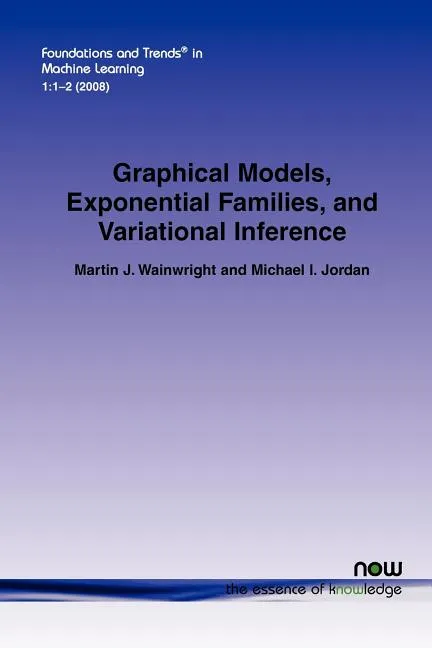
Graphical Models, Exponential Families, and Variational Inference
Report an issue
Tell us what's wrong and we'll take a look.
Thanks – we got it. We'll review and follow up if needed.
The formalism of probabilistic graphical models provides a unifying framework for capturing complex dependencies among random variables, and building large-scale multivariate statistical models. Graphical models have become a focus of research in many statistical, computational and mathematical fields, including bioinformatics, communication theory, statistical physics, combinatorial optimization, signal and image processing, information retrieval and statistical machine learning. Many problems that arise in specific instances-including the key problems of computing marginals and modes of probability distributions-are best studied in the general setting. Working with exponential family representations, and exploiting the conjugate duality between the cumulant function and the entropy for exponential families, Graphical Models, Exponential Families and Variational Inference develops general variational representations of the problems of computing likelihoods, marginal probabilities and most probable configurations. It describes how a wide variety of algorithms- among them sum-product, cluster variational methods, expectation-propagation, mean field methods, and max-product-can all be understood in terms of exact or approximate forms of these variational representations. The variational approach provides a complementary alternative to Markov chain Monte Carlo as a general source of approximation methods for inference in large-scale statistical models.
Michael I Jordan
Michael I. Jordan is Professor of Computer Science and of Statistics at the University of California, Berkeley, and recipient of the ACM/AAAI Allen Newell Award.


Why Readwise Books?
Readwise Books is an ebook & audiobook platform that automatically logs how much you and your friends read, making it fun and easy to read more. Learn more →