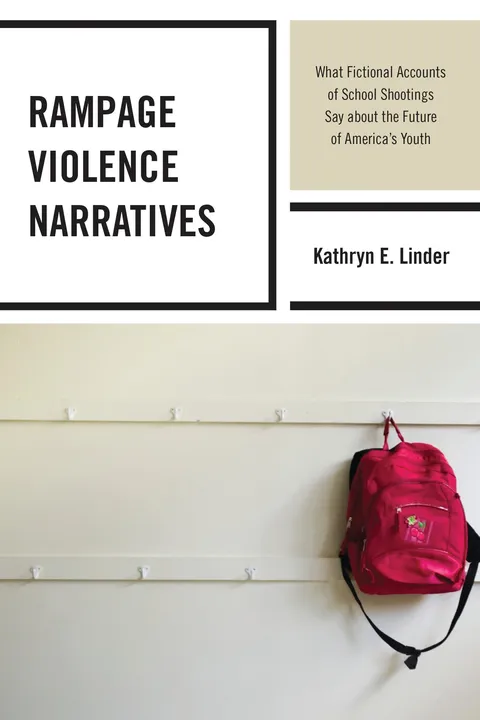
Rampage Violence Narratives
What Fictional Accounts of School Shootings Say about the Future of America’s Youth
Report an issue
Tell us what's wrong and we'll take a look.
Thanks – we got it. We'll review and follow up if needed.
Springfield. Columbine. Sandy Hook. Each school shooting in the United States is followed by a series of questions. Why does this happen? Who are the shooters? How can this be prevented? Along with parents, school officials, media outlets, and scholars, popular culture has also attempted to respond to these questions through a variety of fictional portrayals of rampage violence. Rampage Violence Narratives: What Fictional Accounts of Rampage Violence Say about the Future of America’s Youth offers a detailed look at the state of youth identity in American cultural representations of youth violence through an extended analysis of over forty primary sources of fictional narratives of urban and suburban/rural school violence. Representations of suburban and rural school shootings that are modeled after real-life events serve to shape popular understandings of the relationship between education and American identity, the liminal space between childhood and adulthood, and the centrality of white heterosexual masculinity to definitions of social and political success in the United States. Through a series of "case studies" that offer in-depth examinations of fictional depictions of school shootings in film and literature, it becomes clear that these stories are representative of a larger social narrative regarding the future of the United States. The continuing struggle to understand youth violence is part of an ongoing conversation about what it means to raise future citizens within a cultural moment that views youth through a lens of anxiety rather than optimism.
Kathryn E. Linder
Dr. Katie Linder is currently the executive director for program development at Kansas State University Global Campus. Previously, she directed the award-winning Ecampus Research Unit at Oregon State University. Katie is also a Certified Coach through the International Coach Federation.
Katie is an avid writer and researcher with a passion for process and peeking behind the scenes at what it takes to be a successful academic. For the past several years, her work has focused on blended course design best practices, institutional supports for accessible online learning, and research literacy for scholarship of teaching and learning practitioners and distance education stakeholders. She speaks on topics related to writing and publication; creativity and productivity; self-promotion and personal branding; and teaching and learning with technology.
Her latest works include Going Alt-Ac: A Guide to Alternative Academic Careers (Stylus, 2020; co-authored with Kevin Kelly and Tom Tobin), Managing Your Professional Identity Online: A Guide for Faculty, Staff, and Administrators (Stylus, 2018), High-Impact Practices in Online Education (Stylus, 2018), and The Business of Innovating Online (Stylus, 2019). She is also the author of The Blended Course Design Workbook: A Practical Guide (Stylus, 2016).
Katie earned her BA in English Literature from Whitworth University in Spokane, WA, and her MA and PhD in Women's, Gender, and Sexuality Studies from The Ohio State University.
Visit her personal website at: https: //drkatielinder.com
More by Kathryn E. Linder


Why Readwise Books?
Readwise Books is an ebook & audiobook platform that automatically logs how much you and your friends read, making it fun and easy to read more. Learn more →