Report an issue
Tell us what's wrong and we'll take a look.
Thanks – we got it. We'll review and follow up if needed.
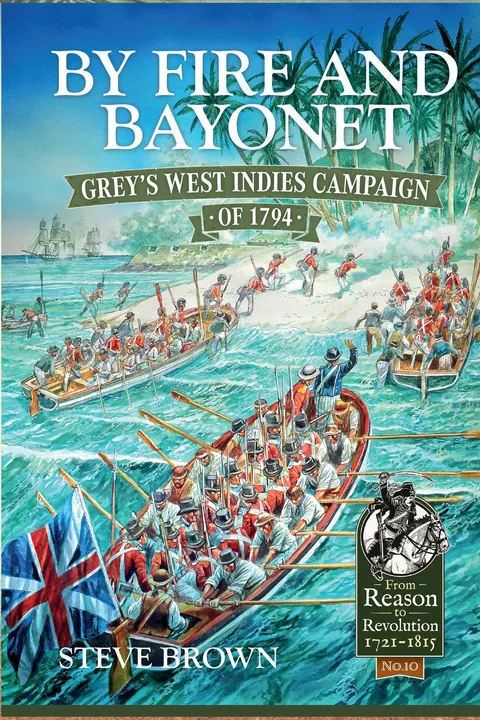
There have been few books about Grey's glorious (but ultimately ill-fated) West Indies campaign in the early years of the long and terrible wars of 1793-1815, yet five of the subalterns in Grey's expeditionary force went on to command divisions in Wellington's Peninsula army; another two commanded the Iron Duke's Royal Artillery; and one (Richard Fletcher) - famously - the Royal Engineers. The tactics used by Sir Charles Grey were as far removed as can be imagined from the traditional image of the two-deep British line delivering massed volleys at pointblank range. The invasions of Martinique, St Lucia and Guadeloupe were raids undertaken by Special Forces, who were instructed to operate in open order, in silence and at bayonet-point; all attacks went in with unloaded muskets. Most of the heavy-duty fighting was undertaken by converged flank battalions, grenadiers and light infantrymen - assembled under hand-picked field officers and used as stormtroopers in every major assault; here were French revolutionary war tactics that are largely unexplored and largely undocumented (at least in modern times). Sir Charles Grey was one of the most aggressive British generals of the era - something his gentlemanly appearance and demeanor did not immediately indicate. Ever cheerful and optimistic - and humane and loyal to his friends - his ability to deliver needle-sharp assaults and then harry a defeated enemy (the latter being something at which British generals of the Napoleonic era were distinctly mediocre) makes him one of the more interesting personalities of the early portion of the 'Great War with France'. If he was not ultimately unsuccessful, it was not his fault: he was robbed of the resources he needed at the outset; then given virtually no reinforcements by Horse Guards. The great killer on this campaign was not the French... it was disease: principally, Yellow Fever. Of the 6,200 men who landed with Grey on Martinique in February 1794, some 4,100 were dead by Christmas - such then is By Fire and Bayonet an account of a very dramatic period for the British Army in the West Indies. It took many years to learn the lessons presented by the campaign, but for the young officers who survived, it provided some invaluable lessons that were put to good use 15 or 20 years later in the British Army of a later era.
Steve Brown
Dr. Steve Brown's invests in the next generation of Jesus-centered leaders and disciples as President of Columbia Bible College in Abbotsford, British Columbia. Over the last twenty-five years, Steve has invested thousands of hours coaching, teaching and walking alongside leaders from Canada, USA and around the world. He served as President of Arrow Leadership for over a decade and he's the author of Jesus-Centered - Focusing on Jesus in a Distracted World, Leading Me - Eight Keys to a Leader's Most Important Assignment, and Great Questions for Leading Well.
Steve's been married to Lea for over twenty-five years and is a proud dad to three young adults.More by Steve Brown












Why Readwise Books?
Readwise Books is an ebook & audiobook platform that automatically logs how much you and your friends read, making it fun and easy to read more. Learn more →